

We have all stood in front of that stack of mail on the kitchen counter, feeling a distinct drop in our energy levels before we even pick up a single envelope.
The Psychological Weight of the "Doom Pile"
It sits there, staring at you. The "doom pile." It is that accumulation of unopened envelopes, flyers, school permission slips, and ambiguous forms that you promised yourself you would deal with "later." But later never seems to come, does it? Instead, the pile grows, and with every inch of height it gains, your anxiety spikes just a little bit more.
As we approach March 10, 2026, we are staring down the barrel of National Organize Your Home Office Day. For many of us, this date on the calendar feels less like a celebration and more like a deadline we are woefully unprepared for. We are right in the thick of tax season. The influx of financial documents, W-2s, and charitable donation receipts is hitting its annual peak. If you don't have a system in place, your dining room table is likely in danger of becoming a permanent archive of stress.
The problem isn't usually that we are lazy. The problem is that traditional filing systems are broken by design. Most organizing advice tells you to categorize things. They tell you to buy pretty color-coded folders and label makers. They tell you to set aside a "filing day" on the weekend.
That advice is wrong. It fails because it assumes you have the mental energy on a Saturday afternoon to sort through a week's worth of administrative debris. You don't. You want to rest. So the pile remains, and the guilt festers. The solution isn't better folders; it is a radically different behavior pattern regarding how you handle the physical object of paper itself.
The Origin and Logic of OHIO
To fix this, we have to look outside the world of home organization and look toward the world of high-performance executive management. The strategy that actually works is called the OHIO method.
OHIO stands for Only Handle It Once.
This concept wasn't invented by a decluttering guru; it was popularized by Robert Pozen, a financial executive and senior lecturer at MIT Sloan, in his work on extreme productivity. Pozen observed something critical about how successful people manage their workload. He noticed that the people who were drowning in work were the ones who would pick up a document, read it, feel unsure about what to do with it, and put it back down on the pile to "think about later."
Every time you do that, you are paying a tax on your time and energy. When you pick that paper up again three days later, you have to re-read it. You have to re-familiarize yourself with the context. You have to remember why it was important. Pozen argues that if you wait to handle these items, you waste significant time and increase your anxiety because you are forcing your brain to process the same data stream multiple times.
He estimates that roughly 80% of the things that land on your desk—or in your mailbox—do not actually require a response or long-term retention. Yet, we treat every piece of paper as if it is a precious artifact that needs a temporary home on our counter.
The logic of OHIO is ruthless but liberating. It dictates that the moment your fingers touch a piece of paper, you are not allowed to put it down until you have made a final decision on its fate. There is no "I'll look at this after dinner." You handle it once, and it never returns to the pile.
The 4-Step Paper Triage
Implementing this requires more than just willpower; it requires a tactical change in your environment. You cannot practice OHIO if you don't have the tools ready to dispose of the paper immediately. You need to set up a defensive perimeter.
Here is how you apply the 4-step triage to your life, starting today:
1. Establish the Entryway Triage Station
The most critical mistake people make is bringing the mail into the kitchen or the living room. Once the mail hits the coffee table, the battle is lost. You must intercept the paper enemy at the front door.
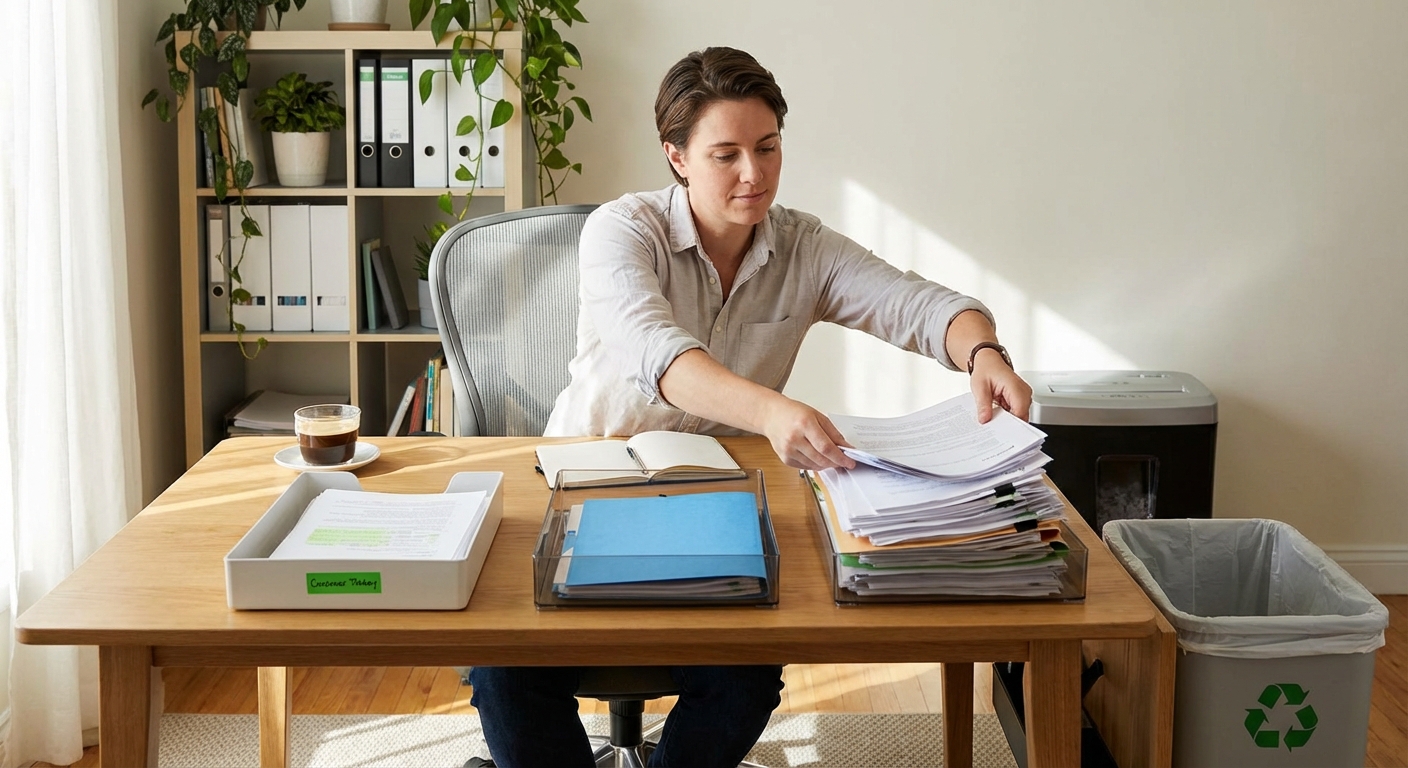
You need to create a triage station right at your entryway. This does not need to be fancy, but it must be functional. This station needs three things: a recycling bin, a shredder (or a "to shred" secure bag), and a single folder marked "Action."
When you walk in the door with a handful of mail, you stop at this station. You do not take your coat off. You do not go get a snack. You stand there and process the stack.
2. The Search and Destroy Phase
Go through the stack. Junk mail, catalogs you never asked for, and credit card offers go instantly into the recycling bin. Sensitive documents that you don't need go into the shredder.
This is where the OHIO principle shines. Statistically, the vast majority of what you are holding is trash. By forcing yourself to make that decision standing at the door, you prevent that trash from ever becoming clutter on a surface in your home. If you put it on the counter, it becomes a task. If you throw it away at the door, it never existed.
3. The 30-Second Rule
Now you are left with the real mail. This is where you apply the 30-second rule. Look at the item. Does it require an action that takes less than 30 seconds?
If it is a permission slip that needs a signature, sign it immediately and put it in your kid's backpack. If it is a bill that you can pay via an app on your phone, pay it right there while standing in the hallway.
I know this sounds intense, but think about the alternative. If you put that bill on the counter, you will walk past it twenty times over the next week. Each time you see it, your brain will whisper, "You need to pay that." That is a mental leak. Plug the leak by doing the task immediately.
4. The "Action" Slot
If the item requires a task that takes longer than 30 seconds—perhaps a complex tax form or a medical bill you need to dispute—it goes into the "Action" folder.
Crucially, this folder is not a storage unit. It is a holding pen for scheduled work. You must schedule a specific time each week (perhaps Friday morning) to empty the "Action" folder. Because you have already filtered out the trash and the quick tasks, this folder should only contain three or four items maximum.
The Science of Simplicity
Why does this method work so much better than just "cleaning up once a week"? It comes down to how our brains handle unfinished business.
Clutter is effectively "delayed decisions." Every object in your house that isn't in its permanent place represents a question you haven't answered yet. When you look at a pile of paper, your brain doesn't just see white rectangles. It sees a list of pending threats and obligations.
Your brain’s CEO gets tired, just like you do. We call this decision fatigue. When you force your brain to look at the same electric bill five times before paying it, you are draining your executive function. You are using up the fuel you need for your job, your family, and your passions on a piece of paper.
As a web developer and marketer who often juggles multiple complex projects at once, I learned this lesson the hard way. I used to let client requests and administrative paperwork stack up on my desk, thinking I was "saving them for a deep work session." In reality, those piles just fractured my focus. I couldn't write good code or design effective campaigns because the corner of my eye was constantly catching the physical manifestation of my to-do list. Once I started processing incoming items immediately—handling them once—my ability to focus on the deep work returned.
There is hard science backing this up. A landmark study from UCLA’s Center on Everyday Lives of Families found a direct link between high densities of household objects and elevated levels of cortisol (the stress hormone). This was particularly acute in mothers, but it affects everyone. When your environment is visually noisy, your cortisol levels spike.
By adopting the OHIO method, you are not just cleaning your house. You are regulating your hormones. You are creating a space of stillness where your mind can actually rest.
Conclusion
The OHIO method is not about being a perfectionist. It is about being a realist. It accepts the fact that we have limited time and limited mental energy. It protects your peace by ruthlessly filtering out the noise before it has a chance to settle in your home.
As we move through March and handle the heavy lifting of tax season, try this experiment for one week. Put a recycling bin by your front door. Do not let a single piece of paper pass that threshold without a decision attached to it.
File it, act on it, or destroy it. But whatever you do, never put it down to deal with later. Your future self will thank you for the silence.
