Throwing away a bag of wilted spinach or a moldy block of cheese isn’t just annoying; it’s the financial equivalent of lighting a twenty-dollar bill on fire. With the USDA forecasting grocery prices to climb another 2.5% in 2026, the margin for error in our household budgets is shrinking. We are paying a premium for survival, yet we treat our pantries like black holes where good intentions go to die.
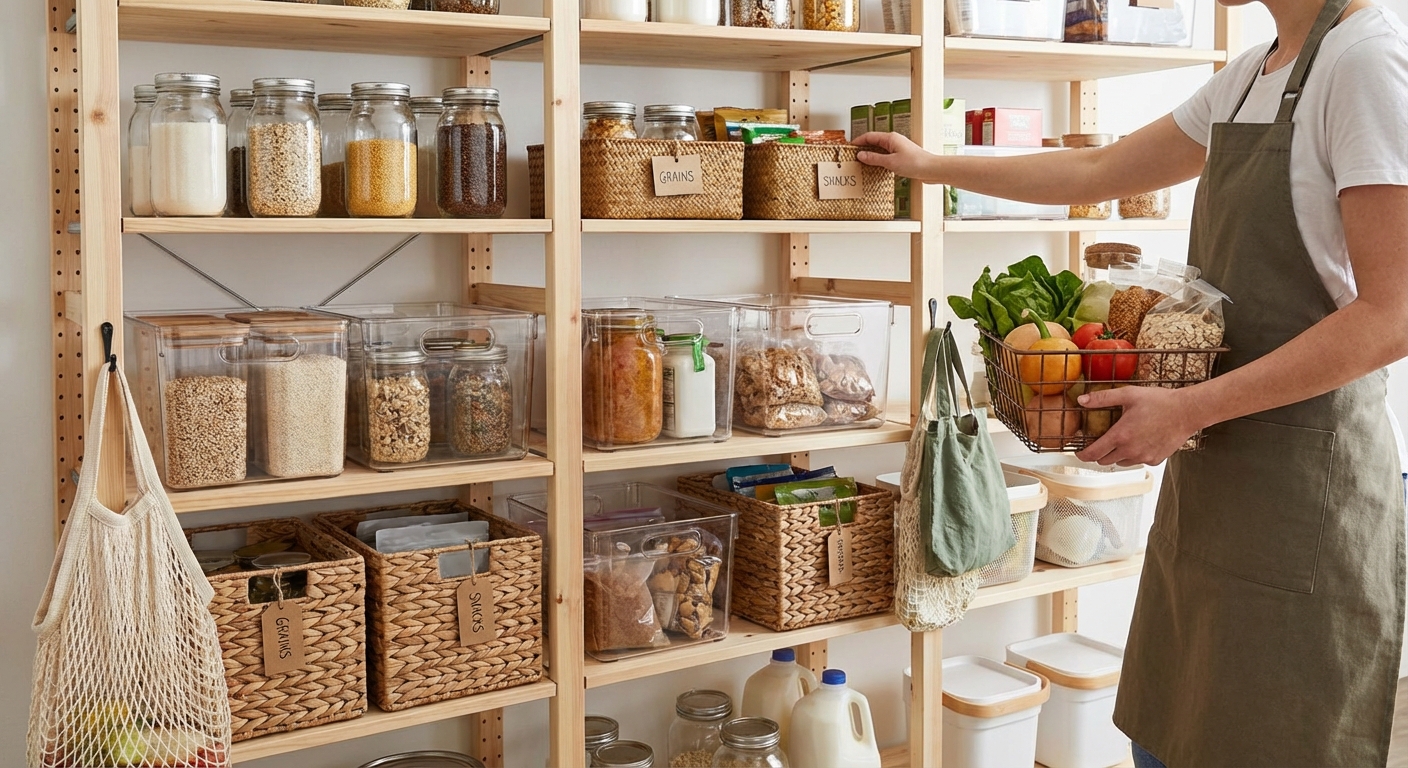
We need to stop pretending that buying food is the same thing as having food available. If you buy ingredients but bury them behind a wall of cereal boxes until they expire, you haven't stocked your kitchen—you’ve just rented temporary storage for your trash. The solution isn't to buy less or starve; it is to steal the logistics manual from the people who can't afford to waste a single ounce: professional chefs.
The Professional Hybrid System
In a commercial kitchen, waste is the enemy of profit. If a restaurant threw away 31% of its inventory—which is what the average American household does—it would be out of business in a month. Chefs use a rigorous system to ensure flow. They don't just shove cans onto a shelf and hope for the best. They operate on logic, speed, and visibility.
The method I advocate for is a "Professional Hybrid System." It takes the industrial rigor of a restaurant line and softens it just enough to make it livable for a family. It relies on a concept called FIFO (First In, First Out), combined with what I call the "3-Second Visibility Rule."
The premise is simple: If you cannot identify an item within three seconds of opening your pantry door, that item does not exist. It is ghost inventory. It will sit there, taking up space and gathering dust, until you find it three years later and wonder why you bought it in the first place. By adopting this hybrid system, you aren't just organizing; you are engineering your environment to make wasting food nearly impossible.
The Four Pillars of the Method
You don't need expensive lucite bins or a label maker to make this work, though they can help. What you need is a change in behavior and a strict set of rules for how matter moves through your space.
Phase 1: The Great Sort and Zonal Mapping
Most pantries are chaotic graveyards because they lack structure. We tend to organize by size—fitting tall boxes on tall shelves—rather than by function. This is a mistake. When you organize by size, you hide ingredients. You need to organize by "zone."
You need to completely empty your pantry. Yes, everything. Wipe down the shelves. Then, map out specific zones based on how you actually cook, not how the boxes fit. I recommend seven functional zones:
- Quick Meals: Things you grab when you have zero energy.
- Dry Ingredients: Flour, sugar, baking powder.
- Canned Goods: Vegetables, sauces, soups.
- Liquids: Oils, vinegars, soy sauce.
- Herbs and Spices: Flavor agents.
- Snacks: High-traffic items.
- Non-essentials: Bulk overstock or special occasion items.
By grouping items by culinary function, you reduce decision fatigue. When you need to make dinner, you aren't scanning the whole pantry; you are looking at the "Quick Meals" or "Canned Goods" zone. This targeted focus prevents you from buying a fifth can of chickpeas because you know exactly where the first four are living.
Phase 2: Decanting for Transparency
This is the step where most people roll their eyes, but it is non-negotiable if you want to stop wasting money. You must take your dry goods out of their original packaging and put them into clear, airtight containers.
I know it feels like extra work. But cardboard boxes are liars. They are opaque. They take up more space than the food inside them warrants. Worst of all, they hide the truth. You think you have a full box of pasta, but really, you have a handful of broken shells at the bottom. You buy more, or you plan a meal and realize too late you don't have enough.
Back when I was working on losing 110 pounds, I learned a hard truth: if I couldn't see it, I either forgot about it or I binged on it later. I had to stop treating my pantry like a storage locker and start treating it like a tool. Decanting saved me because it forced me to confront exactly how much I was consuming. When I poured those snacks into clear jars, the reality of my stock was undeniable. I couldn't lie to myself about how many cookies were left, and I couldn't lose the healthy grains in the back of a dark shelf.
Clear containers allow for an instant visual inventory. You can glance at your pantry and know, within seconds, that you are low on rice. This prevents the "panic buy" at the store, where you buy staples you already have just in case.
Phase 3: The FIFO Rotation Routine
This is the heartbeat of the system. FIFO stands for First In, First Out. It is the golden rule of inventory management.
In a typical home, we come back from the grocery store and shove the new items in the front because it's easy. This pushes the older items to the back. Over time, that can of beans in the back creates a geological layer of ancient food that never sees the light of day.
The FIFO rule dictates that you must do the work when you unpack.
- Step 1: Pull the existing stock forward.
- Step 2: Place the new stock behind it.
You are creating a conveyor belt. The item you bought three months ago should be the next one you grab, not the one you bought today. This rotation ensures that nothing sits long enough to expire. It requires discipline during the unpacking process, but it saves you from the guilt of throwing away unopened food later.
Phase 4: The High-Urgency "Eat Me First" Bin
Even with the best systems, things slip through the cracks. Leftovers get pushed back; produce starts to turn. You need a fail-safe.
Designate one specific bin or shelf area as the "Eat Me First" zone. This should be at eye level—the prime real estate of your kitchen. Any item that is nearing its expiration date, or any produce that looks a little tired, goes here.
Make it a rule for your household: before you open anything new, you check the "Eat Me First" bin. If you're looking for a snack, you look here first. If you're planning dinner, you build it around these ingredients. This creates a funnel for high-risk items, ensuring they get used while they are still viable. It turns a potential waste problem into a creative cooking challenge.
The Science of Waste Reduction
Why does this work? It isn't magic; it's behavioral psychology. We are visual creatures. The "3-Second Visibility Rule" works because it lowers the barrier to usage.
When you look into a cluttered pantry, your brain has to work hard to process the visual noise. It has to filter out the branding, the chaotic shapes, and the shadows to find what it needs. This mental friction leads to what we call "ghost inventory"—items your brain simply decides to ignore to save energy.
By stripping away the packaging (decanting) and enforcing a strict order (zonal mapping), you reduce that friction. You make it easy for your brain to catalogue what you own. When visibility is high, consumption becomes intuitive. You use what you have because you can see it.
Furthermore, the "Eat Me First" bin utilizes the scarcity principle. By isolating items that are "running out of time," you artificially increase their value and urgency in your mind. You aren't just eating an apple; you are "saving" the apple from the trash. It gamifies the process of waste reduction.
Conclusion
We are heading into a year where the cost of living isn't going down. The days of casual abundance, where we could afford to let 30% of our groceries rot, are behind us. We have to be smarter.
Implementing the Professional Hybrid System isn't about becoming a neurotic perfectionist with a label maker. It is about respecting your resources. It is about acknowledging that the food in your house represents the hours you worked to pay for it.
By decanting your goods, organizing by zone, and rigidly applying FIFO, you stop bleeding money. You take control of your kitchen. You move from a reactive state—throwing away spoiled food and panic-buying duplicates—to a proactive state of stewardship. It takes a weekend to set up and a few extra minutes each grocery trip to maintain, but the peace of mind and the money saved are worth every second of effort.