You are standing in the middle of your living room, fully dressed, shoes on, and you are sweating.
You are not sweating because of a workout.
You are sweating because you need to leave in exactly three minutes, and your car keys have vanished into the ether.
You had them in your hand when you walked in with the groceries yesterday. You remember the weight of the metal. You remember the jingle. But now? Nothing. You check the counter. You check the couch cushions. You check the pocket of the jacket you aren't even wearing today.
The panic starts to rise in your chest.
This isn't just about being late. It is about that sinking feeling that you are losing control of your own environment.
We often joke about losing things, blaming "mom brain" or just being scatterbrained. But if you find yourself constantly hunting for your wallet, your glasses, or that one specific charging cable, the problem isn't that you are messy.
The problem is that your home is set up for storage, not for retrieval.
You are fighting against your own biology, and frankly, you are losing.
But you don't have to.
The reason you can't find anything isn't a moral failing. It is usually the result of a specific cognitive behavior called "DOOM" piling, combined with a home design that prioritizes hiding things over using them.
Let's fix it.
The Hidden Culprit: Executive Dysfunction & DOOM Piles
We need to talk about the piles.
You know the ones. There is a stack of mail on the corner of the kitchen island. There is a heap of clean laundry on the chair in the bedroom that you move to the bed to sleep, and back to the chair to sit. There are random screwdrivers and batteries on top of the microwave.
We call this clutter. But there is a more accurate term for it: DOOM piles.
DOOM stands for Didn't Organize, Only Moved.
This is a survival tactic your brain uses when it is running on empty.
When you walk in the door after a long day, your brain's "CEO"—the prefrontal cortex—is exhausted. You are holding a piece of junk mail. To put it away properly, you have to decide if it is trash, if it needs a response, or if it needs filing. Then you have to walk to the trash can, the desk, or the file cabinet.
That requires executive function.
If your battery is drained, your brain refuses to make those decisions. Instead, it opts for the path of least resistance. You set the mail down on the nearest flat surface.
You didn't organize it. You just moved it from your hand to the counter.
The problem is that once you set it down, your brain marks that task as "done" for the moment. The pile becomes part of the landscape. It becomes invisible to you until you need that one specific document, and suddenly you are tearing the house apart.
I see this all the time. It is not that you are lazy. It is that you are trying to force a tired brain to make complex micro-decisions without a system to support it.
The Core Idea: Why Your Brain Quits on You
We tend to think of organization as a physical act. We buy bins, baskets, and fancy labels. We think if we just had more storage space, we would be organized.
But organization is not a storage problem. It is a decision-making problem.
Every item in your house that does not have a permanent, logical home represents a deferred decision. When you look at a cluttered room, you aren't just seeing "mess." You are seeing hundreds of unmade decisions screaming for your attention.
This leads to decision fatigue.
Your brain has a limited amount of decision-making energy each day. By the time you get home, you have likely used most of it up at work, in traffic, or managing your family.
When you force your brain to decide where the scissors go every single time you use them, you are draining that battery further. Eventually, the brain just quits. It stops tracking where things are.
This has real costs.
In fact, Americans lose an average of five items per month and spend nearly 17 hours per year searching for them, a statistic that underscores that this isn't just an annoyance—it is a significant drain on your time and your sanity.
The solution isn't to try harder. The solution is to stop relying on your memory and start relying on a system that works even when you are exhausted.
We need to shift from "storage-first" thinking to "retrieval-first" thinking.
Practical Steps: Building a High-Retrieval Home
Most people organize their homes based on where things fit.
You put the batteries in the junk drawer because there is space there. You put the extra toilet paper in the hallway closet because the shelf is empty.
But retrieval-first design asks a different question: Where would I look for this if I had amnesia?
You need to design your home based on where you use items, not where they fit best.
Here is how to break the cycle of loss and start building a home that works for you.
1. Create Low-Friction Landing Zones
The biggest source of DOOM piles is the transition from "outside" to "inside."
You walk in, and your hands are full. If you have to open a closet door, reach for a hanger, and hang up your coat, you probably won't do it. That is high friction.
Instead, create a landing zone that requires zero effort.
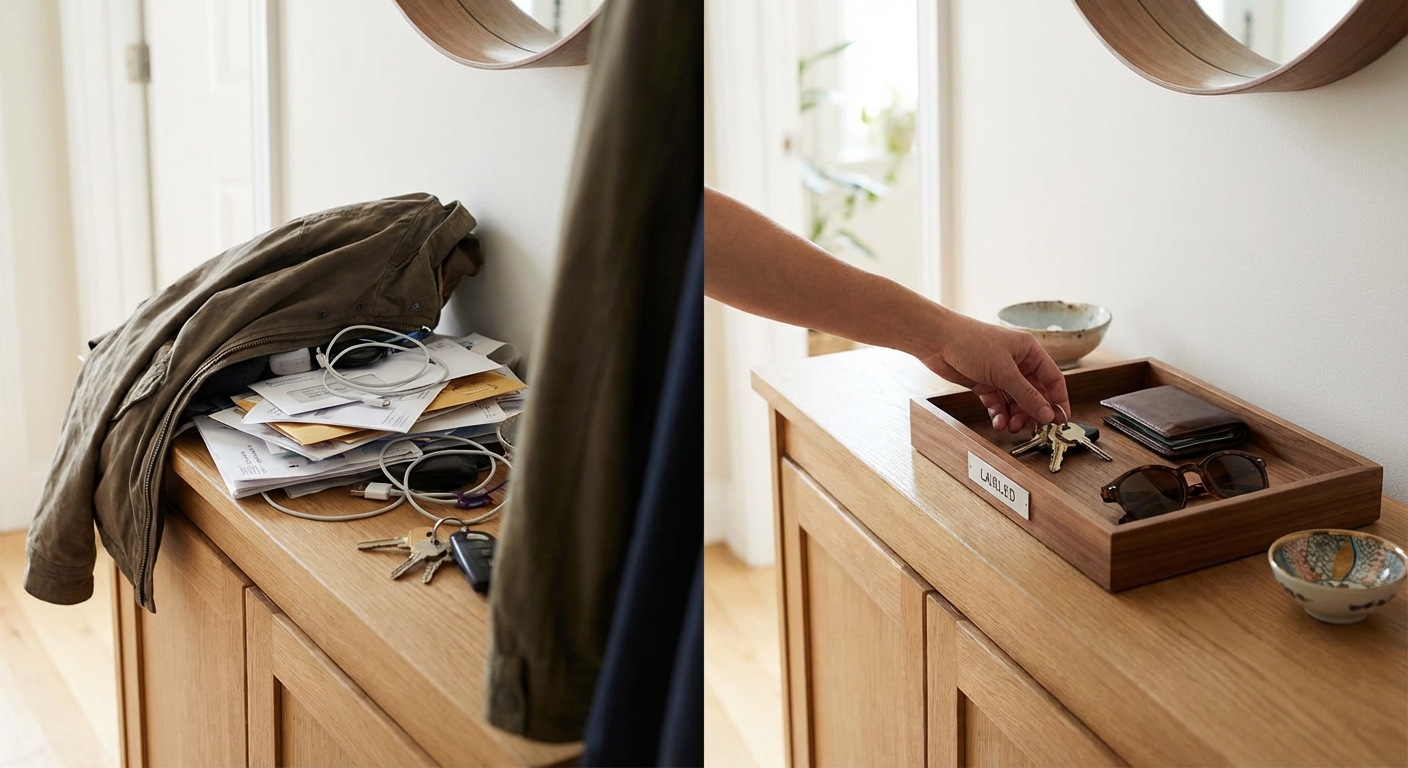
If you always lose your keys, put a bowl or a magnetic hook on the wall immediately inside the door. Not inside a cabinet. Right there.
If you lose your sunglasses, their home should be the last surface you touch before you leave the house.
This is about reducing the number of steps between "having the item" and "putting it away."
2. The Sunday Butterfly Method
This is a trend that is gaining traction for a reason.
We often think cleaning requires a massive, deep-clean energy burst. But usually, we just need a reset.
The "Sunday Butterfly Method" involves spending just 15 minutes moving through your high-traffic areas—like a butterfly flitting from flower to flower.
You aren't scrubbing floors. You are simply looking for DOOM piles.
- Pick up the pile of mail.
- Take the cups back to the kitchen.
- Move the shoes to the rack.
You are resetting the room to neutral. By doing this once a week, you prevent the piles from becoming permanent fixtures that your brain learns to ignore.
3. Combat Decision Fatigue with the "Influencer Method"
Have you ever noticed that high-end pantries on social media often look somewhat empty?
It isn't just for aesthetics. It is a way to reduce cognitive load.
If you have twenty different cleaning products under your sink, finding the glass cleaner is a chore. If you have three products that do everything, grabbing the right one is automatic.
Limit your options.
- Keep only the three spatulas you actually use in the main drawer. Put the other five in a box in the garage.
- Keep only the current season's coats on the rack.
- Keep only the daily toiletries on the counter.
When you reduce the visual noise, your brain doesn't have to scan through twenty items to find the one it needs. You reduce the friction of retrieval.
Why It Works: The Science of Lowering Cognitive Friction
You might be thinking, "This sounds nice, but I'm just a messy person."
I don't buy that.
I used to juggle multiple web development and marketing projects at once, and my desk was a disaster zone of sticky notes and cables. I realized that to get into any kind of deep work burst, I had to clear the physical space first, or my brain just wouldn't settle.
I wasn't messy; I was overstimulated.
When your visual field is cluttered, your visual cortex is constantly processing those stimuli. It is low-level background noise that never shuts off.
This drains the neural resources you need for focus and memory.
By clearing the surfaces and giving every object a specific, logical home, you are quieting that visual noise. You are lowering the cognitive friction of your life.
This is why "clean" feels good. It isn't about hygiene; it is about silence.
It is about giving your brain a break.
When you know exactly where your keys are, you don't have to think about them. You can use that mental energy for things that actually matter—your work, your family, or just a moment of quiet contemplation.
Conclusion
Stop beating yourself up for losing your keys.
The frustration you feel is real, but the solution is not to "try harder" to be organized. You cannot shame yourself into a cleaner house.
The solution is to accept that your brain has limits. You get tired. You get overwhelmed. You get distracted.
Build a home that accommodates that reality.
Embrace intentional ownership. Don't just move piles around. Decide, once and for all, where things belong based on how you live your life.
Create systems that are so easy, even your exhausted, Tuesday-night brain can follow them.
When you do that, you stop losing things. But more importantly, you stop losing your peace of mind.