

You know that sudden jolt when a specific song comes on the radio and, without your permission, you are instantly transported fifteen years into the past? That isn’t just nostalgia; it is a complex neurological event that proves your brain is a time machine.
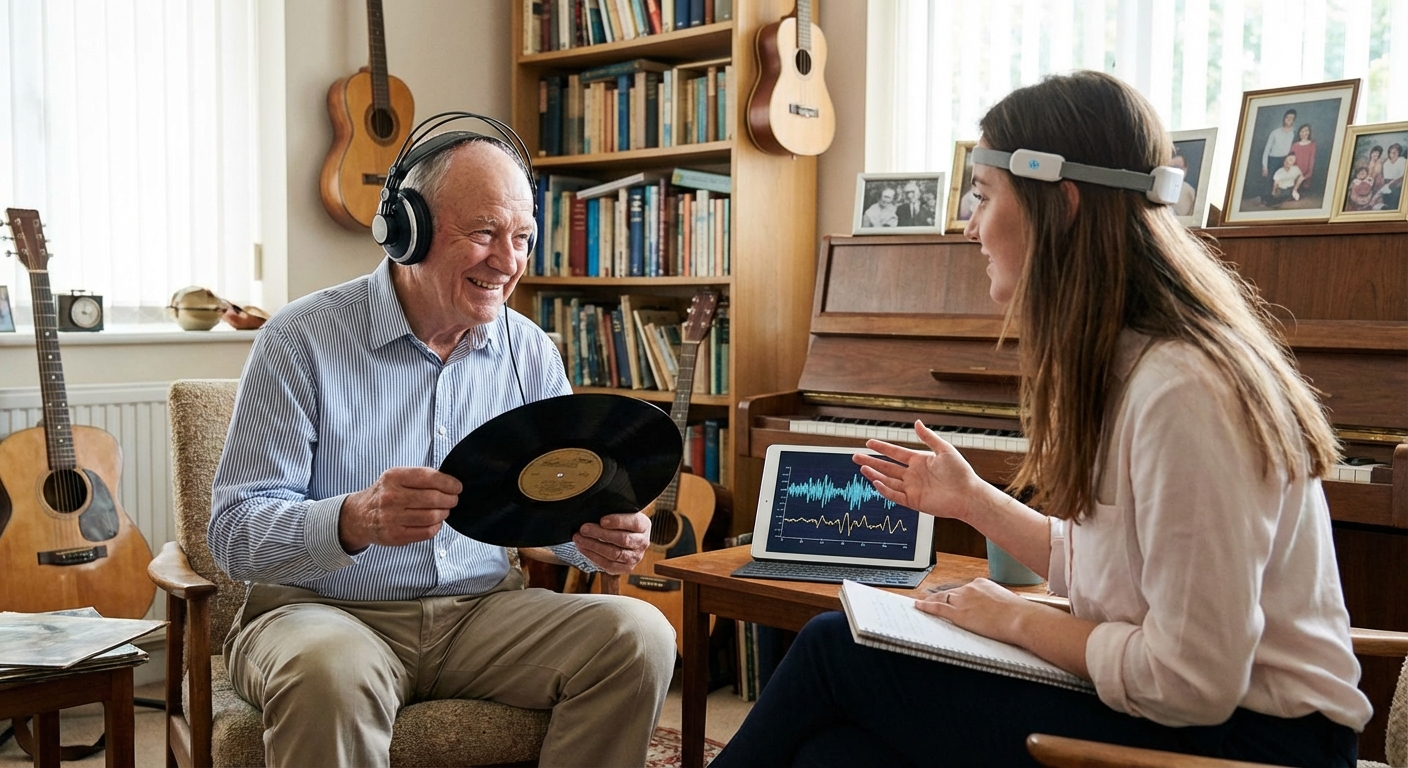
For years, I treated music as background noise. It was something to fill the silence while I worked or something to pump me up while I was at the gym. I didn't give it much thought beyond "I like this" or "I hate this." But as we move further into 2026, the scientific community is handing us a new owner's manual for the human mind, and it turns out that music is one of the most powerful tools we have for cognitive maintenance.
We are seeing new reports from the American Psychological Association this month highlighting how self-selected music is being used to reconnect brain networks, even in people whose memory systems are starting to fail. This matters to you and me right now, not just when we are older. It means that the playlists you build today are actually constructing the structural pillars of your future cognition.
This phenomenon is called Music-Evoked Autobiographical Memories, or MEAMs. It sounds complicated, but the concept is simple: music acts as a high-fidelity key that unlocks specific rooms in your memory palace that other things—like photos or words—simply cannot open.
The Brain’s Sonic Atlas
Let’s get one thing straight: your brain is not just a hard drive filing away data in chronological order. It is an emotional landscape, and music draws the map.
When you look at a photograph of an old vacation, you might recall the facts. You remember where you were, who you were with, and maybe what you ate. But when you hear the song that was playing in the car during that trip, you don't just remember the facts; you feel the wind, the texture of the seatbelt, and the specific emotional weight of that moment.
This happens because of the Medial Prefrontal Cortex (mPFC). Think of the mPFC as the CEO of "You, Inc." It is the hub of your brain responsible for self-identity, social behavior, and decision-making. Recent research suggests that this specific part of the brain is the bridge between music and your sense of self.
When a song triggers a MEAM, it’s often involuntary. You don't ask for it. It just hits you. Research published recently in PLOS One indicates that specific auditory features—like low energeticness mixed with high acousticness—can actually predict whether a memory will be retrieved as vivid and unique or just a blur. The mPFC takes that sound and immediately ties it to your personal history.
I have experienced this firsthand in a way that was actually quite difficult to shake. I quit smoking and vaping a few years ago, and for the most part, the physical addiction is long gone. But there is a specific album I used to listen to on a loop during the peak of my nicotine dependence. To this day, if a track from that album shuffles onto my playlist while I'm driving, I can almost physically taste the vapor. The craving hits me before I even recognize the song title. My mPFC isn't just playing back a melody; it is re-activating the entire sensory experience of that version of myself. It is a stark reminder that our auditory environment shapes our internal reality more than we give it credit for.
Why Music is the Ultimate Memory Key
You might be wondering why you can remember every word to a song that came out when you were sixteen, but you can't remember the song that was number one on the charts last month.
This is due to a phenomenon known as the "Reminiscence Bump." The science shows that your brain is most "plastic"—meaning it is most moldable and sensitive to identity-forming experiences—between the ages of 10 and 30. During this window, your medial prefrontal cortex is developing rapidly. It is hungry for data that helps define who you are.
Music heard during these formative years gets branded onto your neural pathways with a hot iron. It becomes deeply encoded because your brain is actively building the construct of your identity during that time. That is why the music of your youth will likely always sound "better" to you than modern music; it is literally woven into the fabric of your neurobiology.
We are also learning more about cross-modal synchronization. New research released in March 2026 suggests that sound induces low-frequency brain waves that align perfectly with a rhythmic pulse. This creates a "unified" neural response. Unlike a visual cue, which you have to look at to process, or a tactile cue, which you have to touch, music permeates your entire cognitive space. It syncs up your brain waves, creating a level of immersion that explains why a simple melody can bring a grown man to tears in a crowded supermarket.
The connection between the auditory cortex (where you hear) and the limbic system (where you feel) is a superhighway. When that highway is activated by a song from your Reminiscence Bump, the traffic moves faster and hits harder than on any other neural road.
Practical Steps for Cognitive Health
So, how do we use this information? We stop treating music as passive entertainment and start using it as a tool for emotional regulation and brain health. We need to be disciplined about our sonic diet.
Here is a practical protocol you can apply immediately:
1. Curate Your Reminiscence Playlist
Don't just rely on an algorithm to feed you hits. actively build a playlist of songs from your "bump" years (ages 10 to 30). This isn't just for fun; it is a workout for your identity circuits. When you feel unmoored, stressed, or disconnected from yourself, listening to this specific playlist can stimulate the most robust neural pathways you possess. It grounds you in your history.
2. Leverage 40-Hz Stimulation
This is where the science gets really interesting. Emerging studies are suggesting that 40-Hz auditory stimulation—often described as a rhythmic buzzing or pulsing sound—can help clear amyloid-beta from the brain. Amyloid-beta is the "gunk" or protein accumulation linked to Alzheimer’s disease. While we aren't scientists, incorporating rhythmic, repetitive sound into your routine, perhaps during periods of deep work or silence, could be a protective measure for brain longevity.
3. Move With The Beat
You need to engage in "sensorimotor synchronization." That is a fancy way of saying: tap your foot, nod your head, or sing along. New data suggests that the cognitive benefits of music are amplified when you physically engage with the rhythm. It turns passive listening into an active neurological exercise. It boosts the pain-relieving and mood-regulating properties of the music. Don't just sit there; participate in the sound.
4. Use Tools Wisely
We are seeing a surge in AI tools like Matchplus.ai that claim to detect physiological markers of stress and deliver "autobiographical music" to regulate emotions. While technology is useful, do not become dependent on it to tell you how you feel. Use these tools to discover what works, but rely on your own discipline and self-awareness to curate your environment.
The Future of Brain Longevity
We often look for complex solutions to our problems. We want a pill, a surgery, or a breakthrough medical device to keep our brains sharp. But the reality is that some of the most effective tools have been with us all along.
Music is not just a sequence of notes. It is a neurobiological anchor. It holds you in place when the world tries to push you around. By understanding how MEAMs work, we can use music to not only remember our past but to preserve our cognitive future.
The goal isn't just to live longer; it is to live with clarity. If a song from 2005 can wake up a sleeping part of your brain, imagine what a disciplined approach to your auditory environment can do for your mental clarity over the next twenty years.
Turn the music up, but do it with intention. Your brain is listening.

See also in Mindset
20 Problem Solving Frameworks
20 Mental Math Tricks
Why Overthinkers Are Usually the Most Intelligent People
20 Strategies for Building Confidence
20 Ways to Enhance Reasoning
A Simple Question That Reveals Your True Priorities