It seems unfair that the people living in the coldest, darkest corner of Europe are consistently the happiest. But their secret isn't cozy sweaters or candlelight; it's something much wilder.
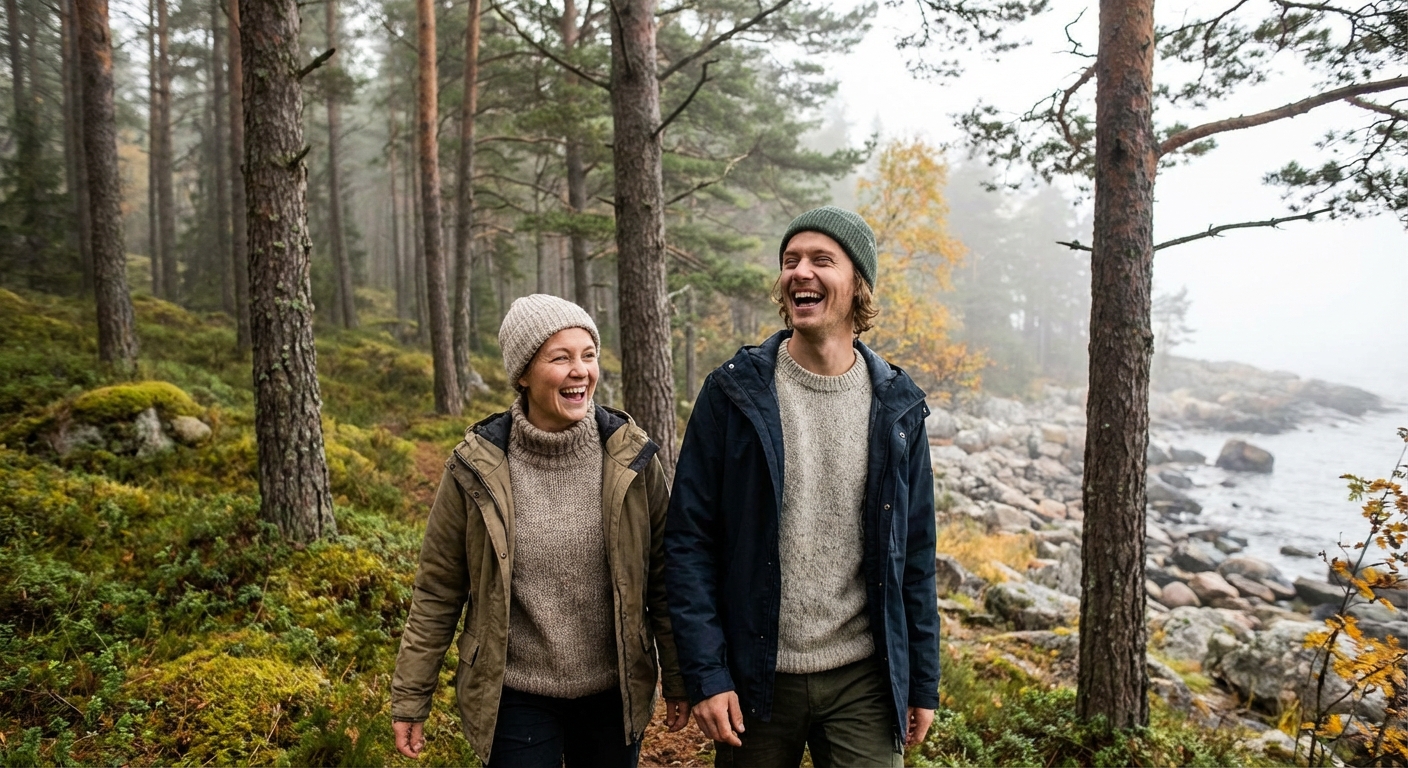
Every year, like clockwork, the World Happiness Report comes out, and every year, the Nordic countries dominate the top spots. It happened again in early 2026. While the rest of the world scrambles to find happiness in apps, supplements, and productivity hacks, Scandinavia just steps outside.
They call it friluftsliv (pronounced free-loofts-liv), which translates roughly to "free-air life." It is the reason why Danes and Norwegians don't just tolerate their harsh winters—they thrive in them. It is not a sport. It is not a hobby you do on weekends. It is a fundamental philosophical commitment to the outdoors as a necessity for the human spirit.
If you are feeling burnt out, wired, or disconnected, the answer probably isn't another self-help book. The answer is opening the door.
The Spiritual Core of Friluftsliv
We tend to complicate well-being. We turn it into a checklist of achievements: did I hit my step count? Did I close my rings? Did I burn enough calories? We treat our bodies like machines that need maintenance.
Friluftsliv rejects that entirely. Coined by the playwright Henrik Ibsen back in 1859, the term wasn't meant to describe exercise. He was describing a spiritual homecoming. It is the understanding that human beings were not designed to sit under fluorescent lights for twelve hours a day. We were made for the wind, the soil, and the open sky.
In Norway, this concept is so baked into the culture that it shapes their identity. It is a "nature-first" mindset. When life gets heavy, they don't retreat into a dark room to binge-watch TV; they head for the treeline. This isn't about escapism. It is about connection.
I often talk about the importance of stillness and discipline in my own life. Many people try to find this through complex mental gymnastics, but friluftsliv offers a simpler route. When you are standing in a forest, or even a city park, and you simply watch the leaves move or feel the cold air on your face, you are practicing a form of quiet contemplation that no app can replicate.
The cultural weight of this philosophy is massive. It implies that being indoors too long is actually dangerous for your soul. It suggests that without that connection to the "free air," we lose a vital part of what makes us human. It brings courage and mental strength because it forces you to engage with the world as it is, not as you want it to be.
The Year-Round Action Plan
The biggest barrier to this lifestyle for most of us is comfort. We are addicted to climate control. We want it 72 degrees and sunny, and if it isn't, we stay inside.
The Scandinavian approach is summarized in a famous saying: "There is no such thing as bad weather, only bad clothes." This is the "No Bad Weather" mindset. It reframes rain, snow, and wind not as obstacles, but as different flavors of the same beautiful world.
If you want to integrate this into your life, you have to stop waiting for the perfect day. Here is how you make it happen.
1. The Wardrobe Nudge
You cannot enjoy the outdoors if you are miserable. The reason most people hate the cold is that they are dressing wrong. You need to adopt the layer-on-layer method. Start with wool base layers. Wool is magical—it keeps you warm even when wet, unlike cotton, which acts like a cold sponge against your skin.
Keep your boots by the door. This is a psychological trick. If your gear is packed away in a closet, you have given yourself an excuse to stay on the couch. If your boots are visible, they act as a physical "nudge." They are a reminder that the outside world is waiting.
2. The 15-Minute Rule
You do not need to scale a mountain. You do not need to drive three hours to a national park. The data shows that even 15 minutes in a "pocket park" or an urban forest can significantly lower your blood pressure and reduce anxiety.
Prioritize accessibility over achievement. Walking around your block in the rain counts. Sitting on a park bench for ten minutes before work counts. It is about the frequency of the connection, not the intensity of the adventure.
3. The Outdoor Commute
Stop looking at your commute as "dead time." If you can walk part of the way to work, do it. If you drive, park ten minutes away. This integrates green space into your existing schedule. You aren't "finding time" for nature; you are layering nature onto the time you are already spending.
I know how hard it is to break the cycle of staying indoors, especially when you are struggling with your health. When I was over 300 pounds, the idea of "exercise" was terrifying. I was ashamed to be seen in a gym, and my body hurt constantly. But walking outside was different. It didn't feel like punishment. I started small—just getting out the door. That simple act of being in the fresh air, away from the pantry and the screens, was the catalyst that helped me lose 110 pounds and stop binge eating. The walls of my house triggered my bad habits; the outdoors set me free.
The Science of Survival and Joy
Why does this work so well? Why does simply looking at trees make us feel better?
It comes down to your nervous system. In our modern lives, most of us are stuck in a state of chronic, low-level "fight or flight." Our phones ping, our emails pile up, and our brain's CEO—the prefrontal cortex—gets exhausted. We are constantly scanning for threats and solving problems.
Nature acts as a hard reset. This is the biophilic connection. Because we evolved in nature, our bodies recognize natural patterns—fractals in leaves, the sound of water, the color green—as "safe." When your brain registers safety, it switches on the parasympathetic nervous system. This is the "rest and digest" mode.
This is why 2026 wellness trends are pivoting toward "ultra-nature." We are realizing that sterile, indoor spa treatments can't compete with the raw, elemental power of the outdoors. The cold wind on your cheeks wakes up your senses. The uneven ground forces your brain to focus on your steps, pulling you out of your looping anxious thoughts.
When you practice friluftsliv, you aren't just getting fresh air. You are regulating your biology. You are giving your nervous system permission to stand down. That creates the space for joy to enter. You cannot be happy if you are constantly on high alert. Nature turns off the alarm.
Redefining the Good Life
We have spent decades building lives that protect us from the elements. We have insulated our houses, heated our car seats, and built cities that allow us to go weeks without touching actual dirt. And yet, we are more anxious than ever.
The Scandinavian philosophy of friluftsliv teaches us that the good life isn't found in comfort. It is found in connection. It is found in the resilience that comes from walking in the rain. It is found in the silence of a snowy morning.
You don't need to move to Norway. You don't need to buy expensive gear. You just need to make a decision. The next time it rains, don't groan. Put on a jacket. Step outside. Breathe. The world is right there, waiting for you to come back to it.