

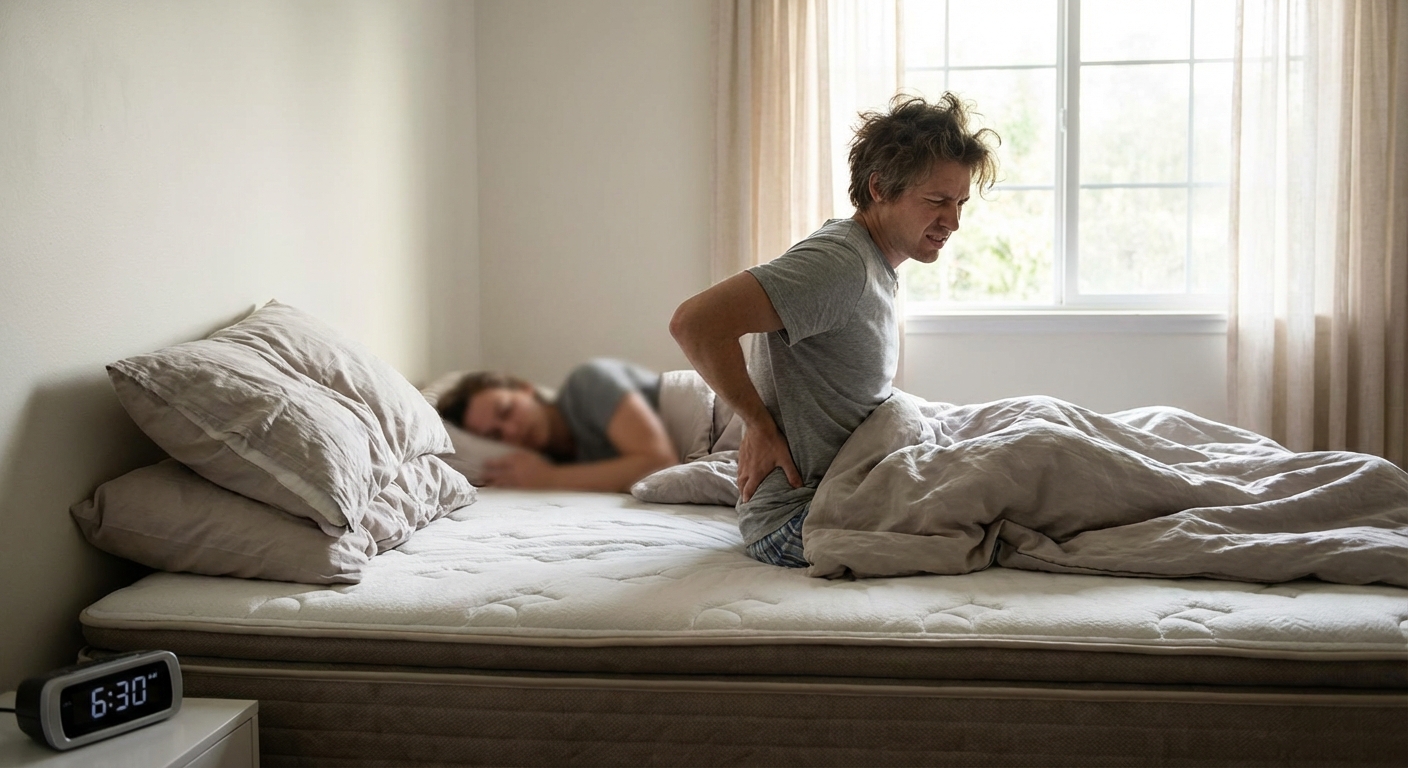
You wake up stiff. You groan as you roll out of bed, grabbing your lower back or rubbing a kink in your neck. You probably blame your mattress, or maybe you blame that extra hour of yard work you did yesterday. But the real culprit is likely much simpler and much more insidious. It isn’t just about how long you slept or how expensive your memory foam is; it is about the geometry of your body while you are unconscious.
The Silent Saboteur of Your Spine
We are approaching National Sleep Awareness Week in March 2026, a time when the world collectively pauses to talk about rest. Usually, the conversation revolves around quantity. We are told to get our eight hours. We are told to put down our phones and avoid blue light. These are all good things, but they miss a critical component of physical health: structural alignment.
Millions of people are evaluating their sleep hygiene right now, yet they are overlooking the fact that a "bad night's sleep" is often a mechanical injury. You wouldn't sit at your desk with your head twisted ninety degrees to the left for eight hours straight. You wouldn't stand with your lower back hyper-arched while carrying a heavy backpack for a third of the day. Yet, that is exactly what many of us do the moment we close our eyes.
If you are a stomach sleeper—sleeping in the "prone" position—you are unknowingly waging war on your own musculoskeletal system. It is widely regarded by orthopedic experts as the absolute worst position for spinal health. It feels comfortable in the moment because it is familiar, but it is slowly destroying your alignment.
Why Stomach Sleeping is a Biomechanical Nightmare
Let’s look at this without the medical jargon. Your spine has natural curves. It is designed to support you against gravity when you are upright. When you lie down, the goal is to keep those curves neutral—essentially, to maintain a straight line from your ears to your hips if someone were looking at you from the side.
Stomach sleeping makes this impossible. It attacks your body from two different angles: the neck and the lower back.
The Cervical Wrench
First, consider your neck. Unless you have figured out how to breathe through a face-down pillow, you have to turn your head to the side to sleep on your stomach. This forces your cervical spine (your neck) into a near ninety-degree rotation.
Imagine sitting in a chair and turning your head as far as it will go to the right. Now, imagine holding it there for six to eight hours. That is what you are doing every night. This twists the vertebrae and puts immense pressure on the nerves exiting the spine. Over time, this leads to chronic stiffness, nerve irritation, and even herniated discs. You are essentially wringing out your neck like a wet towel every single night.
The Lumbar Collapse
Second, consider your lower back. When you lie on your stomach, gravity pulls your heaviest section—your midsection and hips—down into the mattress. This forces your lower back to arch excessively.
In the gym, we call this "hyperextension." It jams the facet joints of the spine together and strains the ligaments that are supposed to hold you together. Instead of decompressing after a long day of standing or sitting, your lower back is being compressed further.
I take this personally because I have dealt with back issues for years. I lift weights three times a week specifically to manage my back pain and keep my core strong. It takes a lot of discipline to get under a barbell when you're tired, but I do it because I know it protects my spine. It drives me crazy to think that I could undo all that hard work and sweat just by lying the wrong way at night. It feels like eating clean all week and then bingeing on junk food all weekend—except you’re doing it while you dream.
Practical Steps for Recovery and Realignment
Changing your sleep position is incredibly difficult. Sleep habits are formed over decades, and your body essentially goes on autopilot when you lose consciousness. If you try to force yourself to sleep on your back, you might stare at the ceiling for hours or wake up on your stomach anyway.
However, if you want to avoid chronic pain, you have to try. Here is a pragmatic approach to fixing your sleep posture, ranging from the ideal solution to "harm reduction" for those who just can't switch.
The Gold Standard: Back Sleeping
Sleeping on your back is generally the best option for spinal alignment, provided you do it right. The gravity is evenly distributed, and your head can remain neutral.
The trick here is the knees. If you lie perfectly flat, it can still pull on your lower back. The fix is simple: place a pillow under your knees. This slight elevation unlocks the hips and allows your lower back to flatten gently against the mattress, maintaining that neutral curve we are looking for.
The Silver Standard: Side Sleeping
Most people find this more comfortable than back sleeping. It is a great alternative, but it comes with its own risks if you don't use props.
When you lie on your side, your top leg tends to slide forward and down to the mattress. This twists your pelvis and lower back, recreating some of the torque we see in stomach sleeping.
The solution is the "pillow sandwich." You need to place a firm pillow between your knees. This keeps your top hip aligned with your bottom hip, preventing that spinal twist. It keeps your hips stacked and neutral.
You also need to check your head pillow. If your pillow is too thick, your head is cranked up toward the ceiling. If it is too thin, your head droops down toward the mattress. You need a pillow that fills the exact gap between your ear and the mattress, keeping your neck in a straight line with the rest of your spine.
Harm Reduction: If You Must Sleep on Your Stomach
If you have tried everything and simply cannot sleep in any other position, you need to minimize the damage. You can’t eliminate the risk, but you can reduce the severity of the arch in your back.
Take a flat, thin pillow and place it under your pelvis and hips. This acts as a shim, lifting your midsection up against gravity and reducing the extreme arch in your lower back.
As for your head, you should use the thinnest pillow possible—or no pillow at all. Using a thick pillow while sleeping on your stomach is a recipe for disaster, as it pushes your neck backward into extension while also twisting it.
Why Alignment Matters: The Mechanics of Rest
We need to stop thinking of sleep as just a mental reset. It is a physical restoration period. Your spine is made of vertebrae separated by discs. These discs are like sponges filled with fluid. During the day, gravity squeezes the fluid out of them.
Nighttime is when those discs rehydrate. They soak up fluid and expand, resetting for the next day. This process relies on "unloading" the spine. If your spine is twisted, torqued, or compressed because of a bad sleep position, those discs cannot fully rehydrate. You wake up with "dry sponges" in your back, which makes you stiff, brittle, and prone to injury.
By prioritizing a neutral spine—where the ears, shoulders, and hips are aligned—you allow your muscles to actually turn off. If your neck is twisted, your muscles have to stay partially contracted to protect the joint. You might be asleep, but your muscles are running a marathon.
Conclusion
We spend roughly one-third of our lives in bed. If you live to be ninety, that is thirty years spent in a sleep position. You cannot afford to spend thirty years in a position that is slowly grinding your joints down.
It will feel weird at first. You will feel restless trying to sleep on your back or side if you are used to the stomach position. But remember the goal: long-term longevity and a life without nagging pain. Use the pillows as tools. Treat your sleep setup with the same seriousness you treat your diet or your work. Your future self—the one who can still turn their head to check a blind spot while driving—will thank you for it.
