The clock hits 5:00 PM. You open the fridge, stare at a half-empty jar of pickles, and feel a wave of dread wash over you. It is the universal question that haunts households everywhere: What are we eating?
The Science of Selective Choice
If that question feels harder to answer in 2026 than it did five years ago, you aren't imagining it. We are living in an era of immense information overload. By the time you clock out of work or finish managing the household for the day, your brain’s battery is flashing red.
There is a popular statistic floating around that claims humans make 200 food-related decisions every single day. While recent research has debunked that specific number as a methodological myth, the underlying sentiment is painfully accurate. The problem isn't necessarily the quantity of choices we make; it is the timing of those choices.
Think of your brain like a CEO. In the morning, the CEO is fresh, caffeinated, and ready to make high-level strategic decisions. But after eight hours of putting out fires, answering emails, and managing crises, the CEO is exhausted. This is what psychologists call "ego depletion."
When you ask yourself "What's for dinner?" at 5:30 PM, you are asking a tired CEO to make a complex logistical decision involving inventory management (what’s in the fridge?), financial planning (can we afford takeout?), and health compliance (should we eat this pizza?).
Approximately 77% of people report being too exhausted to cook after work. This isn't laziness. It is a biological reality. Your cognitive resources are depleted. The "Low-Lift Nutrition" trend dominating 2026 isn't just about eating fiber; it's a response to this collective exhaustion. We are moving away from complex, tech-based calorie tracking and toward simple, "analog" systems that preserve our sanity. The goal is to stop making decisions when you are least equipped to make them.
The "Zero-Decision" Template
The solution to decision fatigue is not more willpower. Willpower is a finite resource, and you usually spend it all before you get home. The solution is a system that removes the need for willpower entirely. We need to automate the process so that "Future You" doesn't have to think.
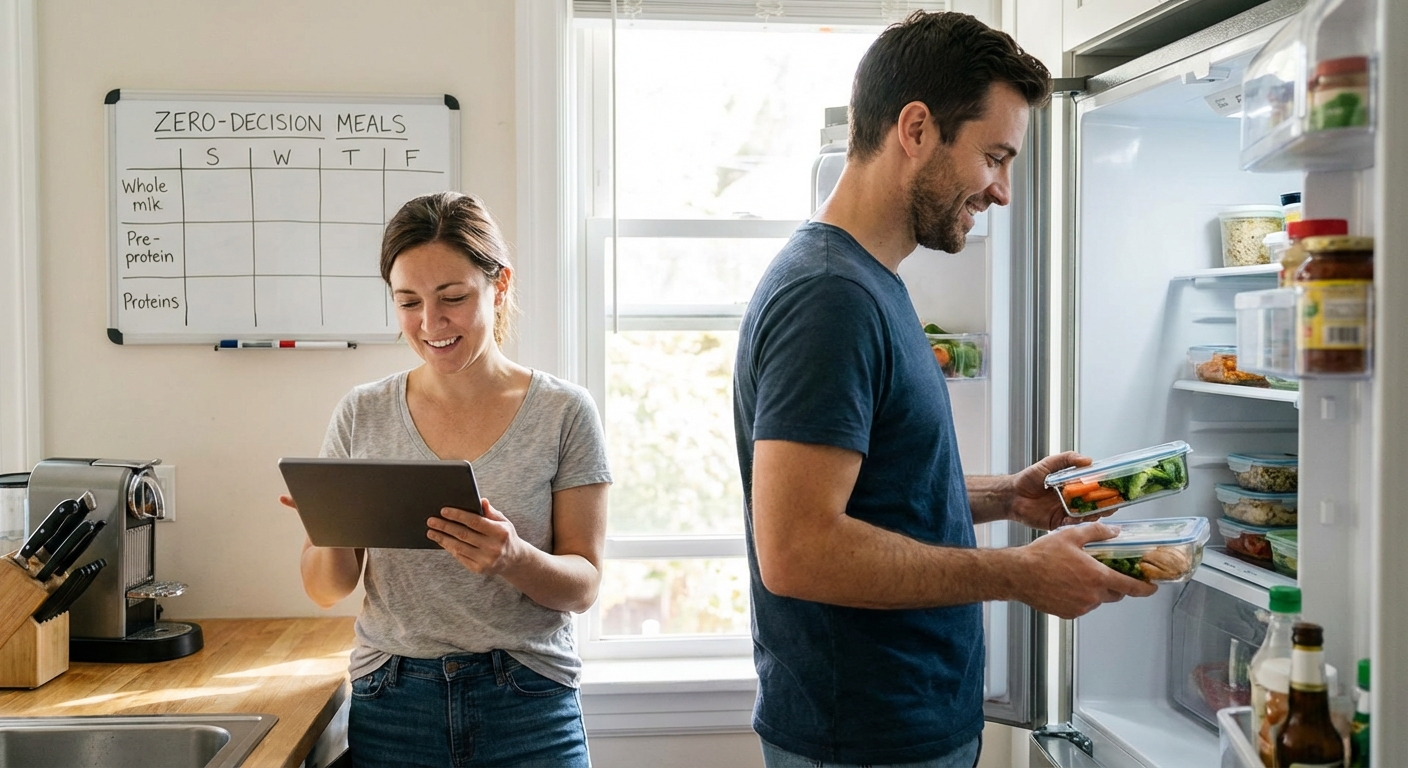
We call this the Zero-Decision Template. It relies on a few core frameworks that strip away the paradox of choice and leave you with a clear, actionable plan.
1. Theme-Based Categorization
The biggest enemy of dinner is the blank slate. When you can cook anything, you often end up cooking nothing. Constraints breed creativity, but more importantly, constraints breed action.
Instead of browsing thousands of recipes online, assign a theme to every night of the week. This drastically reduces your "search space."
- Monday: Meatless (Beans/Lentils)
- Tuesday: Tacos/Wraps
- Wednesday: Rice Bowls
- Thursday: Pasta/Noodles
- Friday: Pizza/Flatbreads
- Saturday: Leftovers/Scrounge
- Sunday: Slow Cooker/Roast
When Tuesday rolls around, you don't have to ask, "What are we having?" You know you are having tacos. The only micro-decision left is what goes inside the taco, which is infinitely easier to solve.
2. The 3-2-1 Ingredient Scaffold
In 2026, we are seeing a shift away from following rigid recipes. Recipes require reading, measuring, and focus—three things you don't have energy for on a Tuesday night. Instead, we use "ingredient scaffolding."
This is formulaic cooking. You shop for and prep a specific ratio of components that can be mixed and matched throughout the week. The magic ratio is 3-2-1:
- 3 Proteins: Choose three protein sources for the week. For example: Shredded chicken, ground beef, and a tin of chickpeas.
- 2 Bases: Choose two starch or grain bases. For example: A big pot of rice and a tray of roasted sweet potatoes.
- 1 Universal Sauce: Make or buy one sauce that ties it all together. Maybe it’s a garlic-tahini dressing or a spicy peanut sauce.
Here is how this plays out in practice. On "Rice Bowl Wednesday," you grab the rice (Base 1), top it with the chickpeas (Protein 3), and drown it in the sauce. On "Taco Tuesday," you use the ground beef (Protein 2) and the sweet potatoes (Base 2) inside a tortilla.
You aren't following instructions; you are assembling blocks. This aligns perfectly with the current "low-lift" dietary trends focusing on high-fiber, shelf-stable foods. Canned beans and frozen vegetables are the heroes of this method because they require zero chopping and zero forethought.
3. The 2:1 Prep Ratio
You do not need to be a "meal prepper" who spends six hours on Sunday filling Tupperware containers. That level of discipline is often unsustainable. Instead, aim for a 2:1 prep ratio.
Every time you cook a component, cook enough for two meals. If you are roasting chicken for Monday, roast two chickens. If you are boiling rice, boil the whole bag. You are already dirtying the pot and heating the oven; doubling the volume takes almost zero extra effort but yields double the output. This ensures that by Thursday, your fridge is stocked with ready-to-eat components, not raw ingredients that require work.
Strategic Savings in an Inflationary World
Beyond the mental relief, there is a hard financial reality to consider. While grocery inflation has stabilized around 2.5% in 2026, restaurant and takeout prices have continued to climb, sitting closer to 4% or higher. The gap between cooking at home and eating out is widening.
However, buying groceries and then letting them rot in the crisper drawer is the most expensive way to eat. This happens because of aspirational shopping—buying kale for the person you want to be, rather than the person you are at 6:00 PM on a Wednesday.
The Zero-Decision Template acts as a hedge against inflation. By moving your decision-making from the "Hot State" (hungry, tired, impulsive) to the "Cold State" (calm, rational, planning mode), you stick to the list.
I know this dynamic intimately. I used to carry 110 pounds more than I do now. A huge part of that weight gain came from the drive-thru window at 5:30 PM. I wasn't actually hungry for burgers; I was hungry for relief. I was desperate for someone else to solve the problem of dinner for me. I had to stop binge eating by taking the choice away from my tired self. I realized that if I didn't have a plan waiting for me at home, I would default to the path of least resistance, which was always expensive and unhealthy.
Structured templates act as a "nudge." Recent data shows that 29% of adults are now setting specific goals to reduce ultra-processed foods. The only way to achieve that without needing the willpower of a saint is to have a system that makes the healthy choice the easy choice.
Why It Works: The Efficiency Principle
The genius of this approach is that it stops treating cooking as an art form and starts treating it as a workflow. Art requires inspiration; workflows just require execution.
When you utilize a template, you are protecting your peace. You are acknowledging that your brain has limits. By looking at your week as a whole rather than a series of daily emergencies, you regain control of your evenings.
The "What's for dinner?" question triggers anxiety because it implies that you need to invent something new. You don't. You just need to execute the plan you made when you were smart, rested, and capable.
This is about reclaiming your time. If you can automate the most stressful hour of your day, you open up space for the things that actually matter—quiet contemplation, time with family, or simply sitting in silence without the nagging guilt of an unplanned meal.
Start simple. Pick three themes. Buy three proteins. Cook a double batch of rice. Watch how quickly the evening dread evaporates when the decision has already been made.