You bought the ergonomic chair with the mesh back and the lumbar support that cost more than your first car. You invested in a standing desk that hums quietly when you press the button. You even bought that weird, squishy floor mat to stand on. Yet, here you are, at 3:00 PM on a Tuesday, rubbing your lower back and feeling like your spine is slowly fusing into a single, solid rod of calcium.
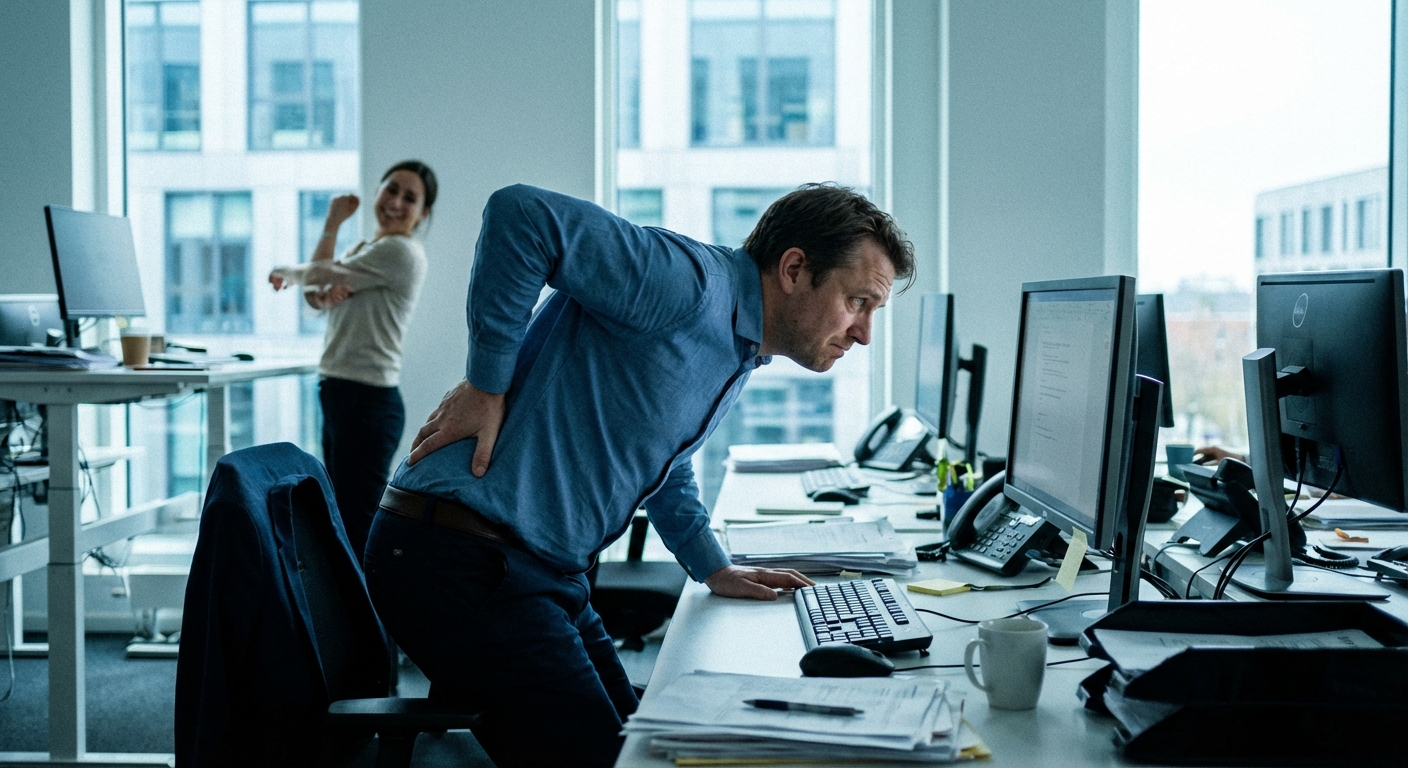
We have been sold a lie that comfort equals health. We assume that if we can just find the "perfect" posture—shoulders back, feet flat, screen at eye level—we can outsmart the biological reality of the human body. But the problem isn't that you are slouching. The problem isn't even that your chair isn't expensive enough. The problem is that you are trying to do something your body was never designed to do: stay absolutely still.
This is the workplace habit that is secretly destroying your back. It is not "bad" posture; it is static posture. We treat our bodies like statues, freezing them in place for eight to ten hours a day, and then we wonder why they crack and crumble like old stone. The modern workplace has engineered movement out of our lives, and the result is a physical and cognitive crisis that is hitting us harder than ever in 2026.
The Silent Spine Killer
Let’s be honest about how we actually work. When you get into the zone—that deep flow state where you are crushing emails, writing code, or building decks—you stop moving. You might maintain that "perfect" ergonomic position for five minutes, but soon, you lock in. Your breathing becomes shallow. Your muscles tense up to hold your skeleton in place against gravity. You might not move your legs for two hours straight.
This stillness is the enemy. The human body is a hydraulic machine. It relies on pressure changes—compression and decompression—to move fluids around. When you sit in a static position, even a "correct" one, you are effectively cutting off the supply lines to your lower back.
The data backs this up. We are seeing a massive surge in musculoskeletal issues, but it goes beyond just aches and pains. As of March 2026, "Digital Fatigue" has emerged as a top cyber-attack vector, with security experts warning that cognitively and physically exhausted workers are significantly more likely to bypass security protocols because they are simply too worn down to care. This isn't just about your back hurting; it is about your entire system degrading because of a lack of movement.
Recent survey data from 2025 reveals that a staggering 93% of office-bound respondents experience back pain during or after sitting. That is almost everyone. If sitting correctly were the answer, that number would be lower. The prevalence of pain proves that the strategy of "better sitting" has failed. We need a strategy of "less sitting."
The Science of Structural Decay
To understand why static sitting is so destructive, you have to understand the mechanics of your spine. Your spine is a stack of bones (vertebrae) separated by soft, gel-filled discs. These discs act as shock absorbers. They allow you to twist, bend, and absorb the impact of walking or running.
However, these discs are unique because they have very poor blood supply. They don't get nutrients and oxygen from a pumping heart like your muscles do. Instead, they absorb nutrients through a process called imbibition, which works like a sponge. When you move, you compress the sponge and squeeze waste out. When you release the pressure, the sponge sucks fresh nutrients and hydration in.
When you sit still for hours, you are keeping that sponge permanently compressed. You are squeezing the fluid out and never letting it back in. Over time, the discs dry out. They become brittle. They lose height. This is why you might feel stiff when you finally stand up—your shock absorbers are flat.
Research shows that static sitting puts approximately 90% more pressure on the back muscles and intervertebral discs than standing. It is a massive load to carry for eight hours. Furthermore, prolonged sitting for more than seven hours a day has been shown to reduce thoracic spine mobility by more than 10 degrees. That means your upper back literally gets stuck. You lose the ability to stand up straight because your body has molded itself into the shape of your chair.
I know this pain intimately. I work as a web developer and marketer, which means I am constantly juggling projects and falling into the trap of "just one more hour" at the keyboard. For a long time, I ignored the stiffness, thinking I could fix it with a few stretches before bed. It didn't work. I eventually had to get serious about my physical discipline. Now, I lift weights three times a week specifically to manage back pain and strengthen my posterior chain, but even deadlifts and squats weren't enough to counteract the chair. I had to change what I did during the workday, not just what I did at the gym.
The 20-8-2 Solution
If the problem is static loading, the solution is dynamic movement. You cannot just buy a better chair and hope for the best. You have to actively manage your relationship with gravity throughout the day.
The most effective framework I have found—and one backed by Cornell University ergonomics research—is the 20-8-2 rule. It is a cycle that forces you to break the static habit before the damage sets in. Here is how it works for every 30-minute cycle:
- Sit for 20 minutes. Do your deep work here. Sit with good posture, sure, but know that the clock is ticking.
- Stand for 8 minutes. If you have a standing desk, raise it. If not, take this time to make a phone call, read a document while standing, or organize your physical workspace. This shifts the load off your lower lumbar discs and engages your leg muscles.
- Move for 2 minutes. This is the non-negotiable part. You must physically leave your station. Walk to the kitchen to get water. Do a lap around the living room. Stretch. This movement pumps fresh fluid back into those spinal discs and resets your circulation.
This sounds like a lot of interruption, I know. You might think, "I can't break my focus every 20 minutes!" But let's be real—you are likely breaking your focus anyway to check your phone or stare blankly at the screen. This structure adds discipline to your breaks. It ensures that when you are sitting, you are fresh, and when you are moving, you are healing.
Beyond the Clock: Dynamic Ergonomics
While the 20-8-2 rule is the gold standard, we have to be realistic. Sometimes you are stuck in a two-hour Zoom meeting where you can't just wander off. In those moments, you need "dynamic ergonomics."
This concept moves beyond the static setup to integrate micro-movements. The first step is to align your environment to support your anatomy, not the other way around. Ensure the top third of your monitor is at eye level. This prevents "Forward Head Posture," where your neck cranes forward to see the screen. For every inch your head moves forward, it adds roughly 10 pounds of leverage weight to your cervical spine. If you are leaning in to read small text, you are effectively hanging a bowling ball off your neck muscles for eight hours.
Second, implement micro-breaks. Even if you can't leave your desk, take 20 to 30 seconds every hour to look away from the screen and move your joints through their full range of motion. Roll your shoulders. Twist your torso gently in the chair. Extend your legs.
The goal is to prevent the "locking" mechanism of the muscles. Your brain is trying to be efficient; if you don't move a muscle, the brain assumes it needs to be tight to hold you up. By moving constantly, you send a signal to your nervous system that it is safe to relax.
Conclusion
Reclaiming your mobility in a digital-first world requires a shift in mindset. We often view our bodies as vehicles that carry our brains to meetings, but the reality is that your physical state dictates your mental performance. A stiff, painful back leads to a tired, distracted mind.
You don't need to become a fitness influencer to fix this. You don't need to spend thousands of dollars on new gear. You need the discipline to respect your biology. The chair is a tool, but it is also a trap. Use the 20-8-2 framework to break free from the statue habit. Treat your spine with the same care you treat your career, and you will find that you not only hurt less, but you also work better. The best posture is simply the next one. Keep moving.