

It is March 2026, and everyone is talking about the "Marcus Aurelius Mental Reset." You have probably seen the headlines. The idea isn't complicated. It suggests that true clarity doesn't come from buying more organizers or downloading new productivity apps. It comes from stripping away the non-essential. It relies on the ancient understanding that your external world is often a loud, messy projection of your internal state.
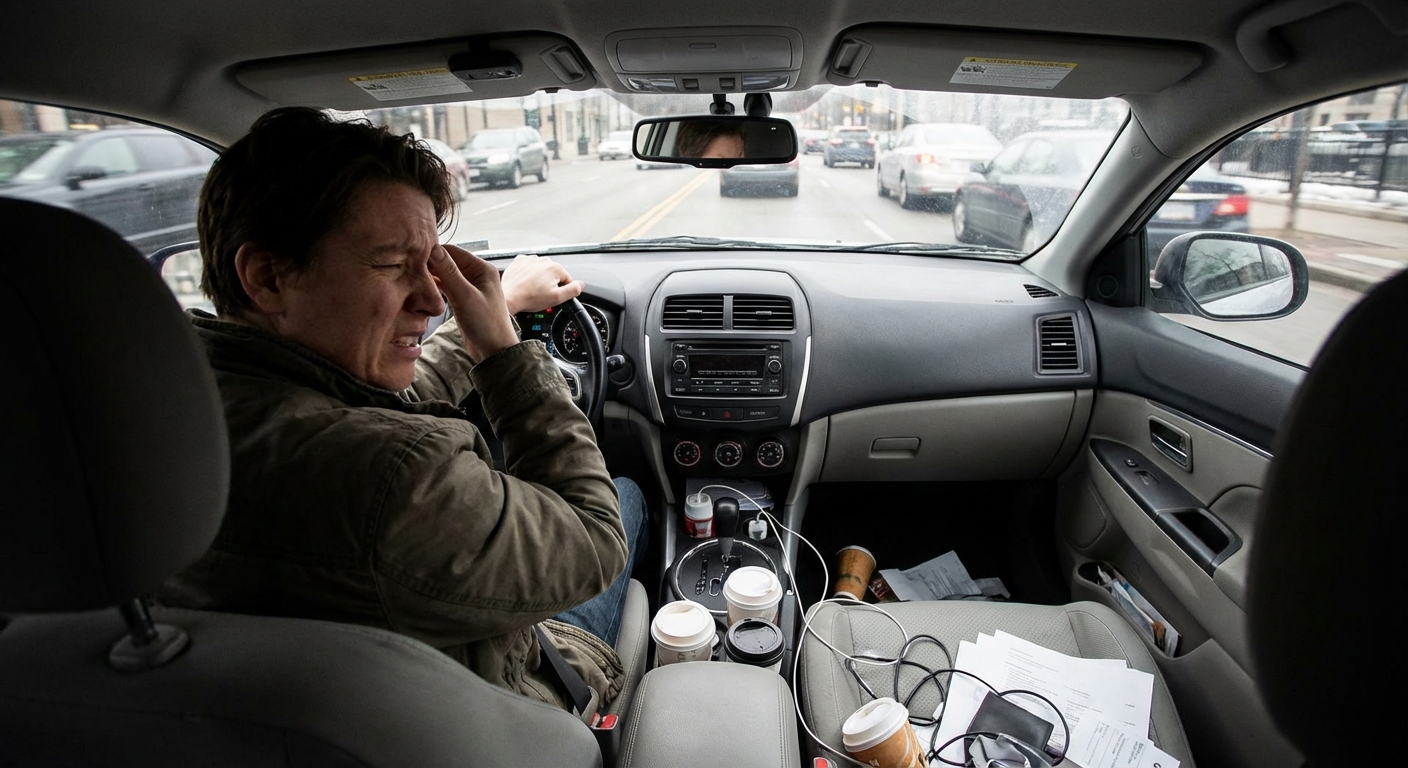
We usually apply this logic to our closets or our email inboxes. But we are ignoring the one space where many of us spend our most stressful, transitional moments: our cars.
Think about your commute this morning. When you opened the door, what greeted you? Was it a clear seat and a dust-free dashboard? Or was it an empty coffee cup from Tuesday, a gym bag you haven’t unpacked, and a layer of dust on the console?
If it was the latter, you aren't just "messy." You are actively sabotaging your brain's ability to regulate stress before you even get to work. Your car is a mobile extension of your mind. If the passenger seat is cluttered, it’s a safe bet that your thoughts are too.
The Biological Mirror
Let’s get the science out of the way, but let’s keep it practical. Your brain is an expensive piece of machinery to run. It consumes a massive amount of energy just to keep you upright and breathing. When you add "executive functions" like decision-making, emotional regulation, and focusing on the road, you are draining the battery even faster.
Clutter acts as a vampire on that battery.
When your eyes scan a dashboard covered in receipts or a floorboard littered with water bottles, your brain registers every single one of those items as a task. It is a visual "to-do" list. You might not consciously think, "I need to throw that away," but your subconscious does. It tags the mess as an "unresolved stimulus."
This prevents your nervous system from settling down. Instead of entering a state of stillness or focus, your brain stays in low-grade "fight or flight" mode. You are essentially driving around inside a stress box.
There is hard data backing this up. A landmark 2025 study published in the Journal of Environmental Psychology found that individuals who perceive their personal environments as cluttered report significantly lower life satisfaction and higher daily spikes in cortisol.
Cortisol is the stress hormone. When it is chronically elevated, you get brain fog, anxiety, and decision fatigue. If you are sitting in traffic surrounded by junk, you are bathing your brain in cortisol right when you need to be calmest.
The Car as a Sanctuary vs. Stressor
We often treat our cars like utility closets on wheels. We toss things in the back seat, thinking, "I'll deal with that later." But the car is actually a "third space." It is the transitional airlock between the demands of your job and the sanctuary of your home.
This space should be sacred. It should be a place of decompression.
When you keep this space clean, you protect your peace. You create a physical boundary that says, "Chaos does not enter here." But when it is dirty, that boundary dissolves. The stress of the road compounds with the stress of the mess.
I know this dynamic intimately. Back when I was carrying an extra 110 pounds and battling a serious binge-eating habit, my car was a disaster zone of fast-food wrappers and hidden shame. I didn't realize until I finally started losing the weight that the chaos in my passenger seat was directly fueling the chaos in my eating habits; cleaning the car wasn't just a chore, it was the first step in reclaiming my self-respect.
The moment I started keeping the car spotless, I noticed a shift in my discipline elsewhere. It was no longer a mobile trash can; it was a vehicle that transported a person who respected themselves.
Because the car is a confined space, visual overstimulation drains your focus more rapidly than it would in a large living room. In a house, you can walk away from a messy table. In a car, you are strapped into a seat, forced to look at the mess for the duration of your drive. Your visual cortex has to process those irrelevant items constantly, leaving you with fewer neural resources for safe driving and emotional control.
Practical Steps for a Mental Reset
You don’t need a professional detailer to fix this. You need a change in philosophy. You need to stop viewing your car as a storage unit and start viewing it as a tool for silence and focus.
Here is how you reclaim your vehicle and your head.
1. The "Clean Sweep" Protocol
This is non-negotiable. Every single time you exit your vehicle, you take something with you.
If you bring a coffee cup in, it leaves with you. If you take off a jacket, it goes inside. Treat your car like a hotel room—you don't leave your personal debris behind for the next guest. In this case, the "next guest" is the future version of you who has to drive to work tomorrow morning. Be kind to that person.
2. Secure the High-Touch Zones
Your sense of control is heavily tied to what you physically touch. Prioritize cleaning the steering wheel, the gear shift, and the door handle.
There is a psychological feedback loop here. When your hands grip a clean, non-sticky steering wheel, it signals to your brain that you are in control of the machine. It reduces subconscious anxiety related to germs and disorder. Keep a small pack of wipes in the glove box. Wipe these surfaces down once a week. It takes thirty seconds, but the payoff in mental clarity is immediate.
3. Engage the Senses
We often ignore how smell impacts our stress levels. A stale, musty car smells like neglect.
Use scent to transform the space. I’m not talking about those cheap pine trees that smell like chemicals. Get a subtle, natural scent. A 2025 study showed that stationary relaxation in a clean, scented vehicle can significantly increase heart rate variability (HRV).
High HRV is a good thing—it means your body is recovering from stress efficiently. When your car smells clean, your brain shifts gears. It moves from "alert and annoyed" to "calm and capable."
4. The Essentialist Filter
This is a Stoic practice applied to upholstery. Look at every object in your car—the sunglasses, the emergency kit, the umbrella, the stack of mail—and ask: "Is this necessary?"
If the answer is no, get it out.
Most of us carry around "just in case" items that we haven't touched in three years. These items are metabolic taxes. They cost you mental energy to ignore. By removing non-essential items, you reduce the price your brain pays to tune out the noise.
The Ripple Effect of Order
This isn't really about having a shiny car to impress your neighbors. It is about the ripple effect.
When you maintain order in your immediate environment, you prove to yourself that you have agency. You prove that you can impose your will on chaos. That feeling of efficacy is addictive. It releases dopamine.
When you step out of a clean car, you walk into your office or your home with a different posture. You aren't dragging the baggage of a messy commute behind you. You are starting the next phase of your day with a clean slate.
There is a deep tradition in the Christian Orthodox faith regarding the physical environment and prayer. The idea is that outer order supports inner stillness. You cannot expect to find silence in your heart if you are surrounded by noise and clutter.
Your car is the modern cell where you spend hours of your life. Make it a place of quiet contemplation, not a mobile junkyard.
Start today. Go out to your car with a trash bag. Throw away the receipts. Shake out the mats. Wipe down the dashboard. It will take you ten minutes. But when you get in tomorrow morning, pay attention to how your shoulders drop and your breathing slows.
A clean windshield leads to a clear mind. Don't underestimate it.
