Walking into a cluttered room feels physically heavy. You might not notice it immediately—we are experts at adapting to our environments—but your body registers the chaos long before your conscious mind does. Your shoulders tense up. Your breathing creates a shallow rhythm. You feel a low-level hum of anxiety that you can’t quite pin down.
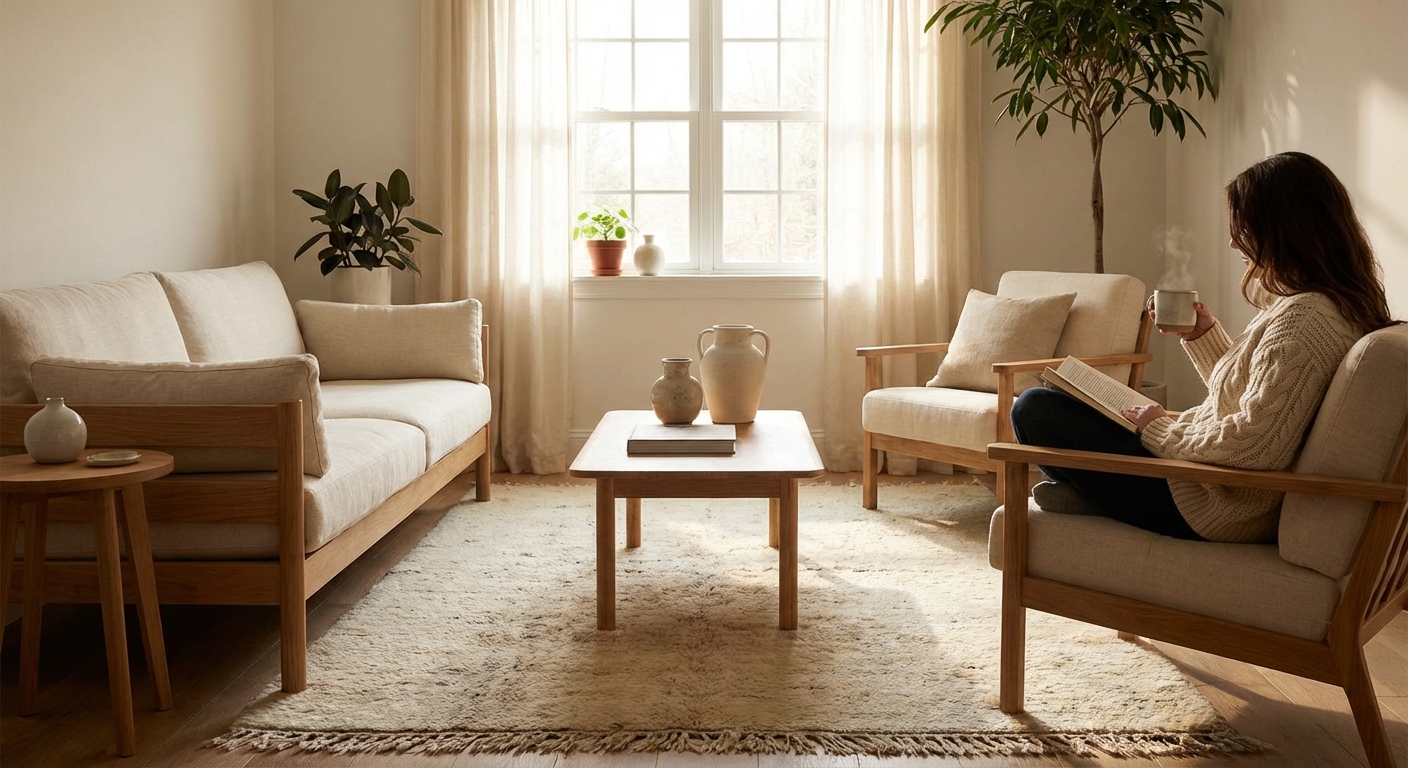
For years, we’ve been sold a version of minimalism that feels more like a punishment than a design choice. We’ve seen the photos of stark, concrete boxes with one uncomfortable chair and a single cactus. That isn't a home; that's a showroom. It feels cold, sterile, and frankly, unlivable.
But there is a shift happening right now. As we move through 2026, the design world is pivoting toward "Human-Centred Minimalism" or "Warm Minimalism." It is no longer about how little you can own; it is about how much peace you can create. It’s about replacing the cold "millennial gray" of the past decade with complex creams, earthy browns, and textures that invite you to touch them.
This isn't just about aesthetics. It is about survival. In a world that is constantly screaming for your attention through screens and notifications, your home needs to be the one place where the noise stops. Decorating with less isn't about deprivation. It is about clearing the path for clarity, rest, and genuine stillness.
The Science of Calm
You might think that ignoring the pile of mail on the counter or the overflow of knick-knacks on the shelf is easy. You tell yourself, "I'm just not looking at it." But your brain doesn't work that way.
Every single object in your room possesses what designers and psychologists call "visual weight." Even when you aren't actively using an object, your brain is processing it. Your visual cortex is constantly scanning your environment, identifying threats, tools, and obstacles. When a room is filled with hundreds of small items—books, cords, decorative bowls, old magazines—your brain is running a background process for every single one of them.
Think of your brain like a web browser. Every object in your room is an open tab. You might not be looking at all fifty tabs right now, but they are all eating up your RAM, slowing down your processing speed, and draining your battery.
This concept is backed by hard data. A landmark study from UCLA established a direct link between high concentrations of household objects and cortisol levels. Cortisol is your primary stress hormone. The study found that women, in particular, showed a spike in stress hormones when dealing with their belongings or talking about their cluttered homes.
Your brain’s "CEO"—the prefrontal cortex—is responsible for planning, reasoning, and impulse control. It gets tired, just like your muscles do. When you force it to constantly filter out visual noise, it depletes the energy you have for actual living. By the end of the day, you aren't just physically tired; you are cognitively exhausted because your environment has been shouting at you for sixteen hours straight.
I work in web development and marketing, often juggling three or four massive projects at once. I’ve learned the hard way that deep-work bursts are the only way I survive. If my desk is covered in papers, coffee cups, and random tech gadgets, my brain spends half its energy filtering that out. I can’t code complex logic when my peripheral vision is screaming at me. I have to clear the decks physically before I can clear the decks mentally.
Practical Steps for "Spatial Expansion"
So, how do we fix this without throwing everything we own into a dumpster? The goal is "Warm Minimalism"—creating a space that feels expansive but also safe and cozy. We want to reduce the visual weight without losing the soul of the home.
Here are four practical techniques to reclaim your space.
1. The Path Test
Humans are creatures of habit. We tend to walk the same "desire lines" through our homes every single day. From the bed to the bathroom. From the entry to the kitchen. From the sofa to the fridge.
Do this test today: Walk your most common routes at a normal pace. Do you have to turn your shoulders to squeeze past a chair? Do you have to step over a rug that always curls up? Do you subconsciously dodge a sharp table corner?
Every time you have to adjust your body to navigate your own home, you are experiencing "micro-friction." It signals to your brain that your environment is an obstacle course, not a sanctuary. Move furniture, clear floor clutter, and open up these arteries. When you can walk blindly through your home without touching a single object, you create an immediate sense of flow and safety.
2. Master the "Vertical Lift"
Most of us decorate horizontally. We line up furniture against the walls and fill surfaces with stuff. This draws the eye down and makes a room feel cramped. You need to draw the eye up.
This is a classic trick that works wonders: vertical rhythm. If you have curtains, mount the rod as close to the ceiling as possible, not right above the window frame. Let the fabric hang all the way to the floor. This trick instantly tricks the eye into believing the ceilings are higher and the room is airier.
Apply this to art as well. Instead of a chaotic gallery wall of twenty small frames (which creates massive visual noise), try placing art slightly higher or using vertical shapes. This stretches the wall visually and gives the room "breath."
3. Prioritize Scale Over Quantity
This is the golden rule of Warm Minimalism. One large, high-quality item is always better than ten small, mediocre ones.
We often make the mistake of buying small decor because it’s cheaper and feels like less of a commitment. But a shelf filled with fifteen tiny candles, figurines, and picture frames creates a jagged, noisy visual line.
Replace the clutter with one large statement piece. A single oversized vase with dried branches. One large, framed print. A substantial ceramic bowl. When you increase the scale of your decor, you can get away with having far less of it. The room feels full and designed, but because there are fewer individual items to process, your brain stays calm.
4. The 3-Item Edit
If you are paralyzed by the idea of decluttering, don't try to do the whole house. Try the "3-Item Edit." This is a wellness hack gaining traction in 2026.
Walk into a room—any room—and identify three items that contribute nothing to your life. Maybe it’s a throw pillow that is always flat, a stack of mail from last month, or a gadget you haven't touched in a year. Remove them. Do not rearrange them. Remove them.
Do this once a day for a week. By the end of the week, you will have removed twenty-one sources of visual noise. You will be shocked at how much lighter the room feels.
Why It Works: The Psychology of Safety
Why does this matter? Why do we care so much about where the curtains hang or how many vases are on the shelf?
Because your home is your "Psychological Home." It is an externalization of your internal state. When your home is chaotic, it reinforces a narrative that your life is out of control. When your home is ordered, it signals safety.
This goes back to our primal wiring. In the wild, an open, clear view meant safety—you could see predators coming. Clutter, deep brush, and chaos meant hidden danger. We may live in apartments now, but that biological software hasn't changed. We crave "prospect and refuge"—a clear view of our surroundings (prospect) and a cozy, protected place to rest (refuge).
Warm Minimalism hits both of these needs. By clearing the clutter, you satisfy the need for prospect—you can see your space clearly. By using warm tones, soft textures, and tactile materials, you satisfy the need for refuge. You aren't living in a barren box; you are living in a cocoon.
Furthermore, clutter is often a time machine. We keep things because of who we used to be, or who we hope to be one day. The guitar we never play. The jeans that haven't fit in five years. The books we pretend we’re going to read.
These items aren't just objects; they are guilt. They are physical reminders of failed goals or past identities. Living with them is like living with a roommate who constantly points out your flaws. When you remove them, you aren't just clearing space on a shelf; you are clearing space in your psyche. You are allowing your home to reflect who you are now, not who you were ten years ago.
Living with Intention
The goal of decorating with less isn't to win an award for the emptiest house. It is to build a sanctuary that recharges you.
We live in a high-stress, high-noise world. When you walk through your front door, the war should be over. Your home should not be another list of tasks, another source of sensory overload, or another drain on your energy.
By embracing Warm Minimalism, you are making a choice to prioritize your peace over your possessions. You are deciding that your mental clarity is worth more than a clearance-rack knick-knack. You are building a space that holds you, supports you, and gives you the strength to go back out into the world and do what you need to do.
Start small. Clear a surface. Open a path. Let the room breathe. And in the silence of that space, you might just find yourself taking a full, deep breath for the first time in a long time.