You’re staring at a tangle of sheets and thinking, "Why bother?" But that sixty-second task is the single most effective way to hack your brain for a better day.
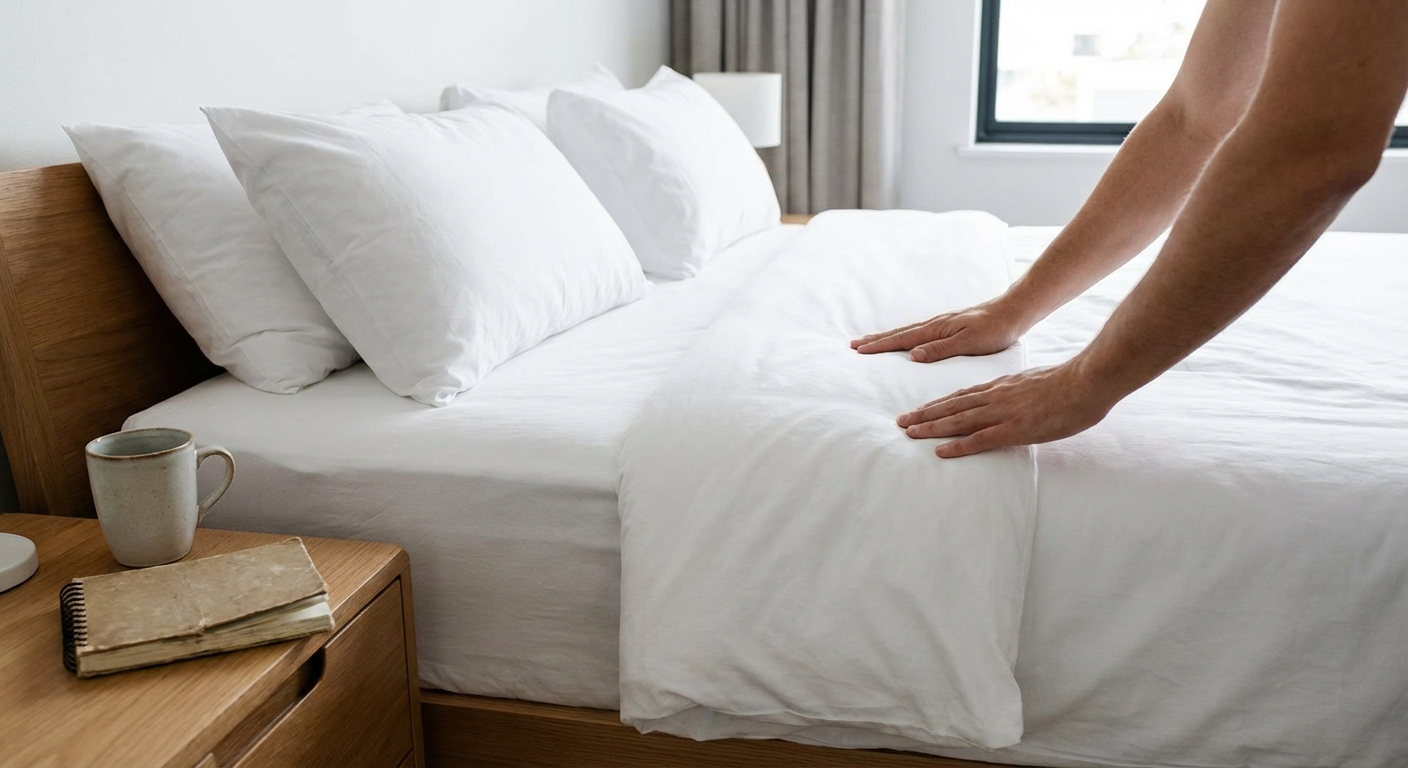
With the National Sleep Foundation marking March 8–14, 2026, as Sleep Awareness Week, we are right on the cusp of the annual "Spring Forward" time shift. We all know the drill: we lose an hour of sleep, everyone is grumpy, and coffee consumption skyrockets. But as experts prepare for this year's campaign to help us become our "Best Slept Self," there is a foundational behavior that keeps surfacing in the research. It isn't a pill, a gadget, or an expensive mattress. It’s the simple act of making your bed.
I know what you are thinking. It feels like a chore your parents nagged you about, a pointless task that just gets undone twelve hours later. But if you look at the mechanics of how your brain functions, making your bed is a serious competitive advantage. It is a lever you can pull every single morning to lower your stress, sharpen your focus, and actually sleep better when you return to the room at night.
The Neurology of the First Win
There is a concept in behavioral psychology called a "keystone habit." The term, popularized by Charles Duhigg, describes a small, specific change that creates a ripple effect throughout your entire life. It’s a domino that knocks over other, bigger dominos.
When you make your bed immediately after waking up, you aren't just tidying a room. You are engaging in an effort-based activity that triggers a release of dopamine. This isn't the cheap dopamine hit you get from doom-scrolling on your phone or eating sugar; it is reward-based dopamine. Your brain registers that you had a task, and you completed it.
This sets a neurological tone for the rest of the day. It signals to your brain that you are a person who takes action. You are a person who imposes order on chaos. It sounds dramatic, but your brain is listening to these signals. When you start with a win, you are statistically more likely to make better choices about your breakfast, your budget, and your workflow.
I know this from experience. I used to weigh 110 pounds more than I do right now. When I was at my heaviest, my life felt like a series of uncontrolled events happening to me. I felt powerless. The journey to losing that weight and keeping it off wasn't about finding a magic diet pill; it was about reclaiming discipline in the smallest areas of my life. I started making my bed. Then I started prepping my meals. Then I started walking. That first small act of discipline in the morning proved to me that I had agency. It was the first "no" to laziness and the first "yes" to the life I wanted to build.
The Hidden Stress of a Messy Room
We often treat our environments as if they are neutral backdrops to our lives, but they aren't. Your environment is constantly communicating with you. When you leave your bed unmade, with pillows on the floor and sheets twisted in a knot, you are creating visual noise.
Your brain’s "CEO"—the prefrontal cortex—is responsible for decision-making, focus, and emotional regulation. It has a limited battery life. Visual clutter forces your brain to process irrelevant stimuli constantly. It’s like having a dozen browser tabs open in the background of your mind; it drains your battery even if you aren't looking directly at it.
A landmark study from UCLA’s Center on Everyday Lives of Families (CELF) drove this point home. Researchers found a direct correlation between the density of household objects—clutter—and elevated levels of cortisol. Cortisol is your primary stress hormone. The study noted that this was particularly acute in women, who often feel a physiological spike in stress when confronted with a messy home environment.
When you leave for work or move to your home office with the bed unmade, you are leaving behind a "stress anchor." Every time you walk past that room, your brain registers the disorder. It’s a subtle, nagging reminder of unfinished business. By straightening the sheets, you are essentially closing that browser tab. You are clearing the cache. You create a space of stillness and order, which preserves your mental energy for the things that actually matter, like your career, your family, or your creative projects.
Better Sleep Through Order
The benefits of this habit aren't limited to your waking hours. There is a strong statistical link between the state of your room and the quality of your rest.
According to data from the National Sleep Foundation, people who make their beds every day are 19% more likely to report getting a good night’s sleep regularly. That is a massive margin. If a supplement promised a 19% improvement in sleep quality, it would fly off the shelves. Yet, we can get that same benefit for free in about sixty seconds.
The reason is psychological association. Your bedroom should serve as a sanctuary. It needs to be a strong cue to your limbic system that it is time to shut down and recover. When the room is chaotic, that signal gets scrambled. A messy bed signals activity, unrest, and a lack of closure.
Think about the feeling of walking into a hotel room. The crisp sheets, the tucked corners, the absolute order—it invites rest. It tells your body, "You are safe here. You can let go." You can recreate that hotel effect in your own home. By smoothing out the duvet and fluffing the pillows, you are preparing the environment for your future self. When you return to the room exhausted at the end of the day, you aren't greeted by a mess that needs fixing. You are greeted by a space that is ready to receive you. It creates a psychological distinction between the chaos of the day and the peace of the night.
Modernizing the Morning Ritual
As we move through 2026, the conversation around sleep environments is evolving. We are seeing a shift away from pure aesthetics toward "Sleep Hygiene Design." It’s not just about what looks good on Instagram; it’s about what makes your nervous system feel safe.
One of the big trends right now is "Pattern Drenching." This involves using coordinated, soothing patterns for bedding, curtains, and even rugs to create a "cocooning" effect. The idea is to envelop the sleeper in a consistent visual theme. When you make your bed using this approach, you are amplifying that sense of safety. You are rebuilding the cocoon every morning so it’s ready for you at night.
We are also seeing a rise in "Reversible Versatility." A lot of the 2026 bedding lines feature high-quality reversible designs. This allows you to flip the duvet and change the "mood" of the room instantly. It satisfies the brain’s need for novelty without the stress or expense of redecorating. If you’re feeling stagnant, flipping the bedding to a fresh color can give you a small psychological reset.
Finally, materials matter more than ever. The push for sustainable, breathable materials like organic cotton and certified sustainable wood is huge this year. These materials regulate temperature better than synthetics. When you make your bed with these natural fibers, you are smoothing out the very tools that keep your body in the deep, restorative stages of sleep.
The Return on Investment
We often overcomplicate self-improvement. We look for the complex routines, the expensive gear, or the radical life overhauls. But usually, the most effective changes are the boring ones. They are the small acts of discipline that we repeat until they become automatic.
Making your bed is a low-effort task with a high-yield return. It costs you one minute. In exchange, you get a hit of dopamine to start your morning, a reduction in cortisol throughout the day, and a significantly higher chance of restorative sleep at night.
As we head into Sleep Awareness Week, don't just read about sleep hygiene. Do the work. Stand up, straighten the sheets, and stack the pillows. It’s a small victory, but it’s yours. And it’s the first step toward reclaiming your peace in a chaotic world.