

You are staring at a blinking cursor, and it feels like the cursor is mocking you. It is 2:30 PM, your lunch has settled into a heavy brick in your stomach, and your brain feels like it is wading through molasses. You reach for another cup of coffee, but deep down, you know it is not going to help. You are just going to be tired and jittery instead of just tired. This is the universal midday slump, and for years, we have been told the solution is to power through it. We are told that stopping is for the weak and that "hustle" means grinding your gears until they strip.
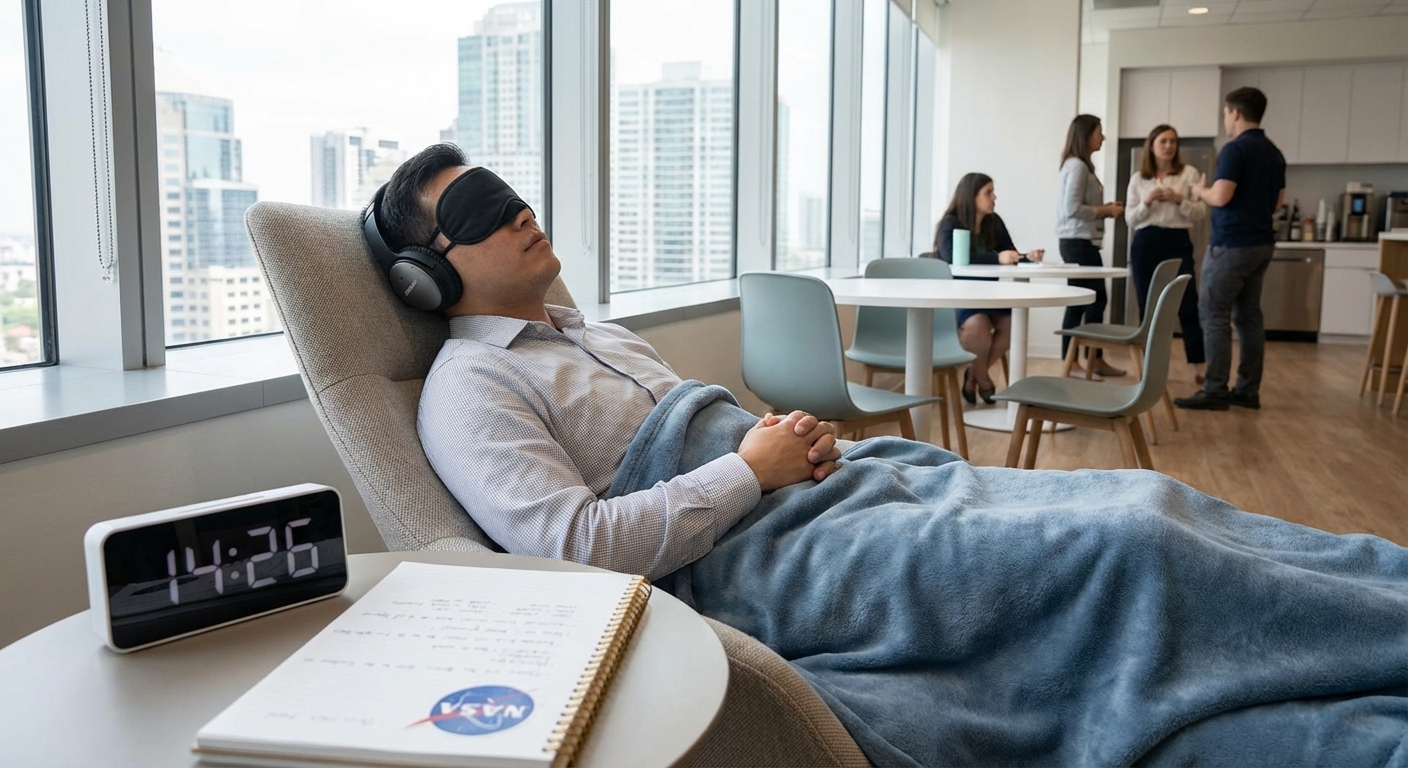
But what if the most productive thing you could do right now is close your eyes? What if the secret to high performance isn’t doing more, but intentionally doing nothing for exactly twenty-six minutes?
The Science of the 26-Minute Reboot
We live in a culture that wears exhaustion like a badge of honor. We brag about how little we sleep and how much we work. But the cracks in that foundation are starting to show, and they are getting dangerous. As of March 2026, the Global Sleep Survey dropped a statistic that should wake everyone up: 53% of people now rank sleep as their number one health priority—ranking it higher than diet or exercise. Yet, in a massive contradiction, 70% of employees admit to taking "snooze days," calling in sick just to catch up on rest. We know we are broken, but we don't know how to fix it.
NASA figured this out decades ago. In the high-stakes world of aerospace, burnout doesn't just mean a bad spreadsheet; it means a catastrophic failure. In 1994, NASA conducted a landmark study on "Fatigue Countermeasures" involving long-haul pilots flying across the Pacific. These pilots were subjected to the same boredom, monotony, and circadian dips that you face in your office chair, just at 35,000 feet.
The results were staggering. The study found that a specific, planned rest period—what we now call the "NASA Nap"—changed everything. Pilots who took a 26-minute nap showed a 34% improvement in performance and a 54% increase in physiological alertness compared to the control group who didn't rest.
Think about those numbers. If I told you there was a pill that would make you 34% better at your job and 54% more alert, you would pay a fortune for it. You would take it every single day. That pill exists. It is free. It is called a nap. But you have to take it the right way, or it backfires.
Your Brain Needs a Hard Reset, Not Just a Pause
To understand why this works, you have to understand what is happening inside your head when you hit that afternoon wall. Your brain isn't a machine that runs indefinitely; it is a biological organ that depletes its resources.
Throughout the day, your brain accumulates a chemical called adenosine. Think of adenosine as "sleep pressure." The longer you are awake, the more it builds up, making you feel slower and heavier. When you sleep, your brain clears this chemical out.
The problem is that most people don't know how to nap. They lay down on the couch on a Sunday, sleep for two hours, and wake up not knowing what year it is. They feel groggy, irritable, and worse than before. This is called "sleep inertia." It happens because you let yourself fall into a deep, slow-wave sleep cycle. Once you enter that deep zone, your brain shuts down for maintenance. Waking it up mid-maintenance is like ripping a computer cord out of the wall during a software update. It doesn't reboot correctly.
The genius of the 26-minute duration is that it keeps you in the lighter stages of sleep. It is just enough time to clear out the adenosine and reboot your working memory—the RAM of your brain—without entering the deep sleep that causes grogginess.
I know this struggle intimately. In my life as a web developer and marketer, I often juggle multiple complex projects at once. There are days when I am switching between writing code, managing client expectations, and trying to fix a broken server. I used to try to force my focus. I would sit there, staring at lines of code that didn't make sense, making mistake after mistake. I was "working," but I wasn't producing value. I was just burning time.
Eventually, I learned to stop fighting. When the fog rolled in, I would step away. I would find a quiet corner, set a timer, and shut down. I wasn't being lazy; I was sharpening the axe. I would wake up twenty minutes later, and suddenly, the solution to the coding problem was obvious. The logic that seemed impossible ten minutes ago was now clear. The rest didn't waste time; it bought me clarity.
How to Execute the NASA Nap Without Getting Fired
You might be thinking, "That’s great for a pilot or a freelancer, but I work in an office. If my boss sees me sleeping, I’m done."
This is a valid concern, but the tide is turning. Companies are realizing that a zombie employee is an expensive liability. However, until your office installs nap pods, you need a tactical approach. You need to treat this like a covert operation. Here is the framework for executing the perfect strategic rest.
1. The 26-Minute Rule
This is non-negotiable. You must set an alarm. If you sleep for too long, you enter the danger zone of sleep inertia. Aim for an alarm setting of 30 minutes total. This gives you about four to five minutes to settle down and relax, leaving you with that "goldilocks" window of 25 to 26 minutes of actual rest. Do not hit snooze. The moment the alarm goes off, you must get up.
2. Optimize the Timing
Biology loves rhythm. Your body has a natural dip in energy between 1:00 PM and 3:00 PM. This is programmed into your circadian rhythm. It’s not just because you ate a sandwich; it’s because your body temperature drops slightly and your alertness fades. This is the path of least resistance. If you try to nap at 5:00 PM, you will ruin your nighttime sleep. If you try at 10:00 AM, you aren't tired enough. Ride the wave between 1:00 and 3:00 PM.
3. Control Your Environment
Light is the enemy of rest. Light signals your brain to stay awake. You need to simulate night. If you can find a dark room, use it. If you are in your car during a lunch break, use an eye mask. It sounds trivial, but blocking out visual input signals your brain that it is safe to disengage. Silence is also key. If you cannot find true silence, use white noise or earplugs to block out the chatter of the office or the street.
4. The Caffeine Hack (The "Nappuccino")
This sounds counterintuitive, but it is one of the most effective tools for alertness. Caffeine takes about 20 to 25 minutes to fully enter your bloodstream and block adenosine receptors. The trick is to drink a small cup of coffee or tea immediately before you lay down.
While you are napping, your brain is naturally clearing out adenosine. Just as you are waking up 26 minutes later, the caffeine is kicking in to block whatever adenosine is left. You get a double-stacked benefit: the natural refresh of the nap plus the chemical boost of the caffeine, hitting you exactly when you need to get back to work.
Redefining Rest as Discipline
We need to change our language around rest. We often equate "stillness" with "laziness." We think that if we aren't moving, we aren't valuable. But in the Christian Orthodox tradition, and indeed in many ancient frameworks of wisdom, stillness is not an absence of action; it is a prerequisite for right action.
There is a profound discipline in stopping. It is easy to run on a hamster wheel; it requires no thought, just reaction. It takes courage to step off the wheel, sit in quiet contemplation, and admit that you are human and you have limits.
When you take that 26-minute break, you are not quitting. You are exercising stewardship over your own biology. You are recognizing that you are a finite creature who needs to recharge to be of service to your family, your work, and your community.
So tomorrow, when the fog rolls in at 2:00 PM, don't reach for the sugary snack. Don't mindlessly scroll through your phone, which only exhausts your brain further. Find a quiet spot. Set your timer. Close your eyes. Embrace the silence. When you wake up, you won't just be awake; you will be ready.

See also in Productivity
How To Make Boring Tasks Feel Fun
10 Techniques for Effective Planning
15 Deadline Management Strategies
15 Tips for Managing Remote Teams Effectively
The Accountability Partner Research That Shows You’re 95% More Likely to Succeed
15 Morning Productivity Rituals