Your environment is silently shaping your brain. If your walls are bare, your lighting is harsh, and your routine is static, you might be starving your mind of the fuel it needs to stay sharp.
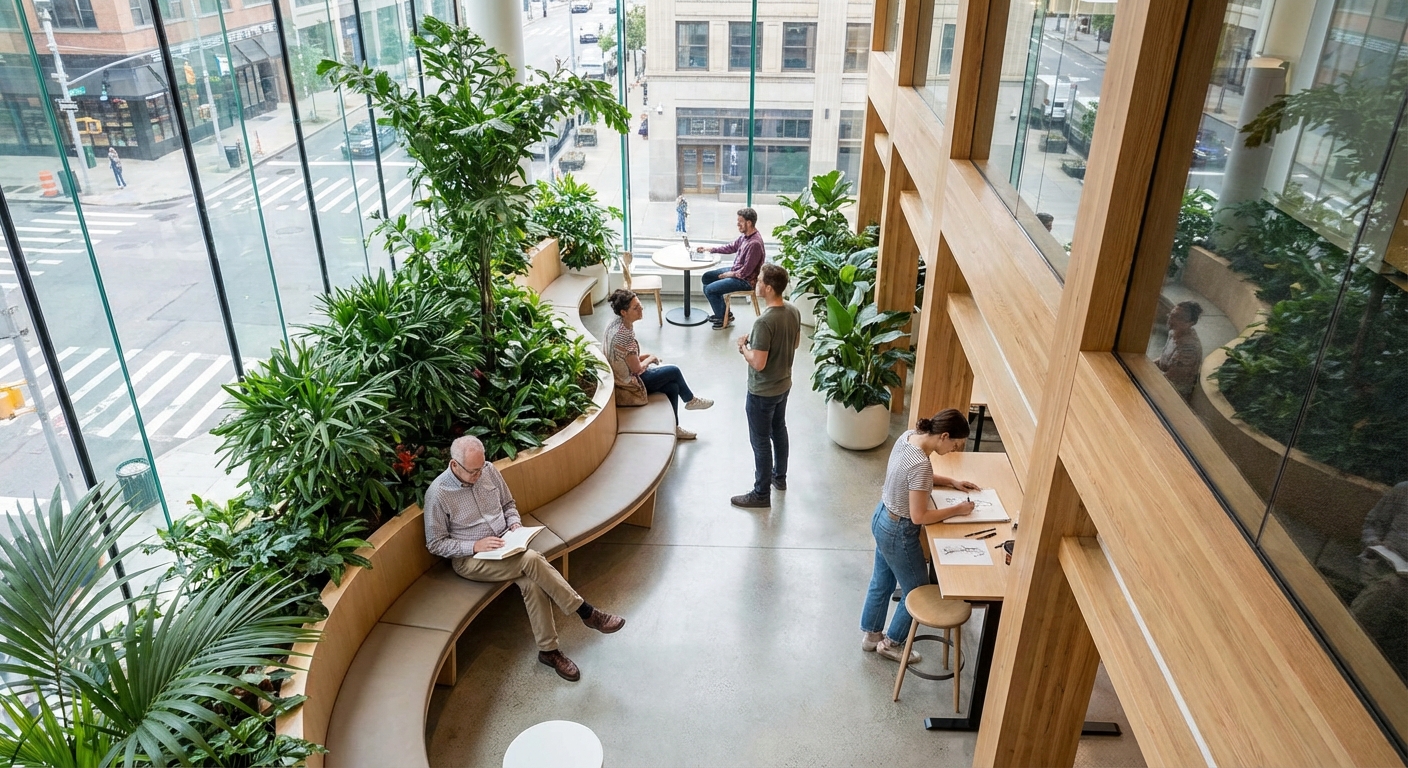
The Neuro-Architecture of Change
Most of us treat our homes and offices like storage containers. They are just places where we keep our bodies while we wait for the next task or the next day. We assume that as long as we have a roof over our heads and a Wi-Fi connection, we are doing fine. But new research is tearing that assumption apart.
We have known for a long time that our surroundings affect our mood. You know the feeling of walking into a sterile, gray hospital waiting room versus stepping into a sunlit library with warm wood tones. One drains you; the other energizes you. However, until recently, we viewed this as purely emotional. We thought it was just a matter of "vibes."
We were wrong. It is biological.
The Salk Institute has declared 2026 the "Year of Brain Health," and for good reason. We are seeing a massive shift in how we understand the relationship between the outside world and our inner biology. A landmark study published just last month in Neurology dropped a bombshell that should wake us all up. It revealed that high levels of lifelong intellectual enrichment—things like reading, visiting museums, and engaging in complex games—can delay the onset of Alzheimer’s disease by five years. It can delay mild cognitive impairment by seven years.
Think about that time frame. Five to seven years is a lifetime when you are talking about connecting with your grandchildren or maintaining your independence.
This concept is called "Environmental Enrichment," or EE. In the lab, scientists realized that if you put a rat in a plain, empty box with just food and water, its brain stagnates. But if you put that same rat in a "Disney World" cage—filled with tunnels, wheels, toys, and other rats—its brain physically grows. The neurons branch out. The connections multiply.
Humans are no different. We just have bigger cages. When your environment is complex, novel, and stimulating, your brain responds by building better hardware. When your environment is flat, predictable, and dull, your brain goes into power-saving mode, and eventually, it starts to atrophy.
The Biology of Brilliance
You might be wondering how a potted plant or a different paint color translates into a smarter, more resilient brain. It sounds a bit like magic, but the mechanics are surprisingly concrete. It all comes down to a protein called Brain-Derived Neurotrophic Factor, or BDNF.
I like to think of BDNF as fertilizer for your brain cells. It is a protein that supports the survival of existing neurons and encourages the growth of new synapses and neurons. This process is called neuroplasticity.
For a long time, we thought the adult brain was fixed—that you had a set number of neurons and that was it. We now know that the brain is plastic. It can change, adapt, and grow throughout your entire life, provided you give it the right stimulus.
Recent findings from March 2026 have sharpened our understanding of this mechanism. We used to think this process took weeks or months. But new data suggests that stimulating environments can trigger a rapid release of BDNF specifically in the hippocampus—the part of your brain responsible for memory and learning. This release induces immediate remodeling of dendritic spines.
In plain English? When you challenge your brain with a new environment or a complex task, your brain cells literally sprout new connection points to handle the load.
This builds what scientists call "Cognitive Reserve." Think of this as a savings account for your mind. If you spend your life building up a massive reserve of neural connections through rich experiences and stimulating environments, your brain becomes resilient.
Research shows that people with high cognitive reserve can actually tolerate physical damage to the brain better than those with low reserve. You could have the physical signs of aging or even pathology like amyloid plaques, but your brain has built so many "workarounds" and alternative pathways that you keep functioning at a high level. You stay sharp because you built a redundant system.
Actionable Environmental Enrichment
So, how do we apply this? You probably cannot hire a team of neuro-architects to rebuild your house tomorrow. But you don't need to. You can hack your own environment to mimic the principles of high-end neuro-architecture.
The goal is to move from a "static" space to a "living" space. We want to create an environment that challenges the brain rather than putting it to sleep.
1. Implement Neuro-Adaptive Lighting and Sound
Our brains are wired to sync with the sun. Yet, most of us sit under flickering fluorescent tubes or static LEDs that blast the same intensity of light at 8:00 AM as they do at 8:00 PM. This confuses your biological clock and drains your cognitive energy.
In 2026, high-tech buildings use sensors to adjust lighting based on the occupant's stress levels. You can do the low-tech version. Get smart bulbs that shift from cool, blue-enriched light in the morning (for focus) to warm, amber light in the evening (for wind-down).
Pay attention to sound, too. Total silence isn't always best, but chaotic noise is destructive. Create "zones" in your home. Have a space for high-energy work with music, and a dedicated space for absolute silence and stillness.
I know the power of this firsthand. I used to be a heavy gamer. I remember days when my entire world was a glowing monitor and a dark room. I was glued to the screen, "doom-scrolling" or gaming for hours on end. My environment was static, digital, and dead. My brain felt the same way—sluggish, anxious, and stuck. It wasn't until I physically changed my setting—quitting the games and forcing myself into the real world—that the mental fog lifted. By replacing that digital cage with real-world complexity, my focus returned.
2. Prioritize Biophilic and Curved Design
"Biophilic design" is just a fancy way of saying "bring nature inside." But it is more than just buying a succulent. It is about mimicking the complexity of the natural world.
Nature is rarely filled with perfect straight lines and sharp 90-degree angles. Sharp corners can actually trigger a subtle, subconscious "threat" response in the amygdala. We are wired to be cautious of sharp things. Conversely, curved shapes and natural views lower heart rates and boost creativity.
So, soften your space. If you have a room full of sharp, boxy furniture, add a round rug. Put a large, leafy plant in the corner to break up the straight lines. If you can, position your desk to face a window with a view of trees or the sky. If you are staring at a blank drywall, you are depriving your visual cortex of the complexity it craves.
3. Build "Mind Gyms" into Your Daily Life
We have gyms for our muscles, but we treat cognitive exertion as a chore. We need to reframe this. Public spaces like libraries and museums are being reimagined as "mind gyms"—places you go specifically to sweat mentally.
In your own home, create friction. Make the "easy" entertainment hard to reach and the "rich" entertainment impossible to ignore. Hide the remote control in a drawer. Put a book, a puzzle, or a musical instrument on the coffee table.
We often talk about discipline as a mental act, but discipline is often just environmental design. If you design your space to nudge you toward complexity—toward learning a new skill, reading a difficult text, or engaging in deep prayer or contemplation—you remove the willpower friction.
Conclusion
We are entering a new era where we realize that our biology is not separate from our geography. The spaces we inhabit are partners in our cognitive health.
If you want to protect your brain, delay decline, and feel more alive right now, look around you. Is your environment feeding you, or is it starving you?
You don't need a million dollars to fix this. You need to introduce novelty. You need to prioritize natural light. You need to soften the hard edges. You need to respect the fact that your brain is a survival machine designed to adapt. If you give it nothing to adapt to, it will wither. If you give it a rich, complex, beautiful world, it will rise to the occasion.
Start today. Move the furniture. Buy the plant. Change the lights. Your brain will thank you for it in five years.