If you are reading this, there is a high probability that your shoulders are tense, your jaw is tight, and your breathing is shallow. We are living in an era where our biological hardware is hopelessly mismatched with our digital software. We were built for the variability of the outdoors, yet we spend our days in climate-controlled boxes, staring at glowing rectangles that demand our constant attention.
It is March 2026, and the statistics are grim. Over a billion people are grappling with anxiety and burnout. We treat stress as a badge of honor or an unavoidable tax on modern life, but your body keeps the score. It tells you something is wrong through sleepless nights, digestive issues, and a pervasive sense of dread.
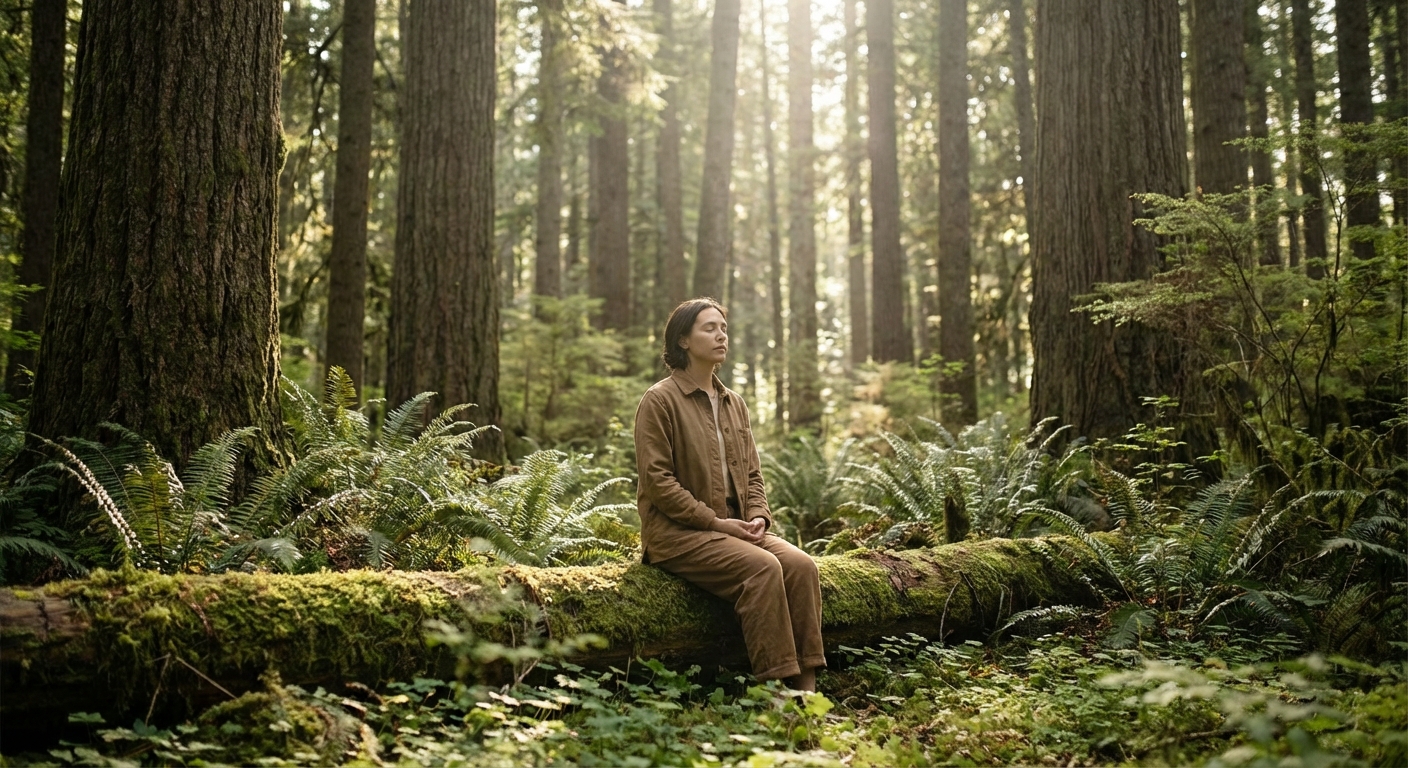
The antidote might not be another app or a complex routine. It might be stepping outside. But I am not talking about a power walk or checking your step counter. I am talking about Shinrin-yoku, the Japanese practice of forest bathing. This isn't about hiking to the top of a mountain to conquer it; it is about letting the environment conquer your stress. And unlike many wellness trends that rely on vague promises, this one is backed by hard, cold data.
From Technostress to Forest Medicine
We have a new word for what many of us feel daily: "technostress." It is the specific type of burnout that comes from constant connectivity and information overload. Your brain’s CEO—the prefrontal cortex—gets tired, just like you do. When it is overworked, you lose your ability to focus, your patience wears thin, and your anxiety spikes.
In the 1980s, the Japanese government noticed this trend emerging in their workforce. They didn't just tell people to "relax." They turned to their forests. They coined the term Shinrin-yoku, which translates to "forest bathing" or "taking in the forest atmosphere."
The concept is simple but profound. It is not exercise. It is not a hike. It is a physiological shifting of gears. It is the practice of immersing yourself in nature using all five senses. It is about what you hear, what you smell, and what you feel. While this sounds poetic, the Japanese approached it with scientific rigor. They wanted to know if trees could actually change human biology. As it turns out, the answer is a definitive yes.
The Cortisol Connection
Let’s talk about cortisol. You have likely heard of it referred to as the "stress hormone." Cortisol is necessary—it wakes you up in the morning and helps you respond to danger. But in our modern world, the alarm bell never stops ringing. Chronic high cortisol is a wrecking ball for your health. It destroys your sleep, packs fat around your midsection, and weakens your immune system.
This is where the research gets interesting. Dr. Yoshifumi Miyazaki from Chiba University and researchers from Nippon Medical School didn't just ask people how they felt after a walk in the woods; they measured their biomarkers.
They conducted comprehensive field experiments across 24 different forests in Japan. They took urban dwellers, put them in a forest environment, and measured their salivary cortisol levels against a control group in a city setting. The results were not subtle.
The researchers found that spending time in a forest environment led to a 12.4% average decrease in salivary cortisol levels compared to urban environments. That is a massive drop. It suggests that the forest acts as a natural brake pedal for your nervous system.
Dr. Miyazaki calls this the "physiological adjustment effect." The theory is that our bodies evolved in nature. For 99.9% of human history, we lived in the wild. Our physiological functions are adapted to a natural environment, not a concrete jungle. When we return to nature, our body recognizes it as "home." Our blood pressure drops, our pulse rate slows, and our endocrine system stops screaming "emergency."
Beyond the Mind: The Power of Phytoncides
It is easy to think that we relax in nature simply because it is quiet or pretty. But there is actual chemistry happening between you and the trees. It’s in the air you breathe.
Trees and plants emit invisible chemical compounds called phytoncides. These are antimicrobial volatile organic compounds—essential oils like α-pinene and limonene—that trees use to protect themselves from rotting and insects. When you walk through a forest, you are inhaling these compounds.
This isn't just a pleasant smell; it is a biological interaction. When you breathe in phytoncides, your body responds by boosting its own defense systems. Dr. Qing Li, a leading expert in forest medicine, conducted a landmark study showing that a three-day trip to the forest increased the activity of Natural Killer (NK) cells by 50%.
NK cells are a type of white blood cell that plays a critical role in your immune system. They are your body's first line of defense against viruses and tumors. The incredible part is that this boost isn't temporary. Dr. Li found that the increased NK activity lasted for up to 30 days after the trip.
Think about that for a moment. Just by breathing the air in a forest, you are upgrading your immune system. You aren't just calming your mind; you are arming your body against disease. It turns the act of walking through the woods into a legitimate preventive health strategy.
The "Dosage" of Nature
So, how do you actually do this? Do you need to move to a cabin in the woods? Thankfully, no. The research is very clear on the "dosage" required to see these benefits. You do not need to become a survivalist to lower your cortisol.
I work as a web developer and marketer, constantly juggling projects and deadlines. There are days when my brain feels like a browser with a hundred tabs open, and the fan is spinning so loud I can’t hear myself think. I used to try to power through that mental fog with more caffeine or by staring harder at the screen. It never worked. I found that stepping away—truly away—was the only way to stop the spinning. I realized that my best work didn't happen when I was grinding my gears; it happened after I stepped outside and let the silence reset my focus.
Here is the research-backed framework for effective forest bathing:
1. The 20-Minute Rule
You do not need to spend all day outside. The data suggests that spending a minimum of 20 minutes in a forested area is enough to trigger that significant drop in cortisol. This is the threshold where the physiological shift begins. If you can do more, great, but 20 minutes is the "minimum effective dose."
2. Slow Down
This is the hardest part for high-achievers. We are conditioned to get from Point A to Point B as fast as possible. Forest bathing is the opposite. It is aimless. If you are sweating or panting, you are exercising, not forest bathing. Exercise is great, but it stimulates the sympathetic nervous system (fight or flight). To activate the parasympathetic nervous system (rest and digest), you must move slowly.
3. Engage the Senses
This is about sensory synchronization. To get out of your head, you must get into your senses.
- Look: Notice the patterns in the leaves, the texture of the bark, the way the light filters through the canopy.
- Listen: Listen to the wind, the birds, or the crunch of leaves under your feet. Silence is rare in the modern world; drink it in.
- Smell: Take deep breaths. Hunt for the scent of pine, earth, and rain. That is the phytoncides doing their work.
- Touch: Place your hand on a tree trunk. Feel the moss. Ground yourself physically in the environment.
4. Regularity Over Intensity
A massive retreat once a year is nice, but consistent exposure is better. A 2025 meta-analysis suggests that frequent, short exposures (10–30 minutes) are highly effective at maintaining lower baseline blood pressure and cortisol. Think of it like a daily vitamin rather than a yearly surgery.
Reintegrating Forest Therapy
We often view nature as a luxury—a place we visit on vacation or on a rare free weekend. But the science of Shinrin-yoku suggests that nature is a necessity. It is a fundamental piece of our biological puzzle that has been missing.
The "physiological adjustment effect" is real. Your body is constantly trying to return to a baseline of health, but the noise and stress of the city keep pushing it off balance. The forest offers a reset button.
You don't need expensive gear. You don't need a guide. You just need to find a patch of trees, leave your phone in your pocket (or better yet, the car), and walk slowly.
In a world that is constantly screaming for your attention, the quiet of the forest is the most radical tool you have. It offers stillness in an age of chaos. It offers clean air in an age of pollution. And most importantly, it offers a return to yourself.
Next time you feel the walls closing in, don't reach for a pill or a drink. Go to the trees. Breathe. Let the chemistry of the forest do the work. Your body knows what to do; you just have to give it the right environment.