It is March 2026, and the landscape of mental health is shifting right beneath our feet. If you look at what is happening in North Carolina right now, you will see state-funded "Peer Cafes" popping up—safe, non-clinical spaces designed to keep people out of psychiatric emergency rooms. In New Mexico, Area 46 of Alcoholics Anonymous is preparing for its assembly, marking over nine decades of a movement that changed the world. While these might seem like two separate news items, they are part of the same lineage. The modern push for "peer support"—where someone who has walked the walk helps another—is not a new invention of the digital age. It is the direct descendant of a desperate experiment that began in Akron, Ohio, in 1935.
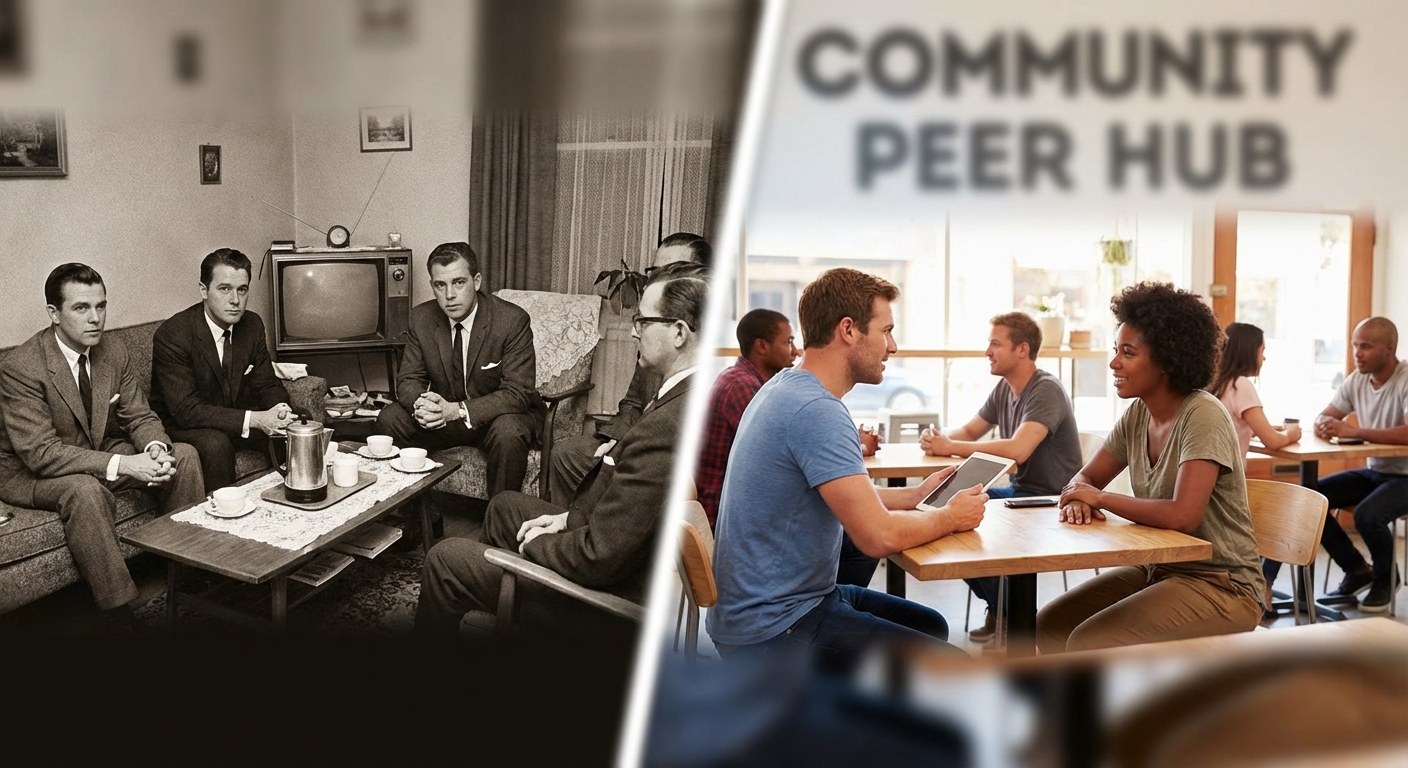
We often think of innovation as high-tech, complex, and driven by experts with PhDs. But the most effective social technology we have for combating despair and addiction wasn't invented in a lab. It was invented in a hotel lobby by a man who was trying not to take a drink. To understand where we are going with mental health today, we have to look back at the blueprint drawn up by Alcoholics Anonymous. It pioneered the very concept of "mutual aid," proving that sometimes, the only person who can help you is someone who is just as broken as you are.
The Spark in Akron
To understand the magnitude of what happened in 1935, you have to understand what it was like to be an alcoholic before then. In the early 20th century, addiction wasn't viewed with the nuance we have today. It was seen almost exclusively as a moral failing or a lack of willpower. If you couldn't stop drinking, you were considered weak. The medical treatments of the time were often brutal and ineffective, involving forced confinement in sanitariums, heavy sedation, or "cures" that simply didn't work. You were isolated, shamed, and largely written off by society.
Enter Bill Wilson. Bill was a New York stockbroker who had crashed and burned. He was brilliant, charismatic, and completely unable to stop drinking. He had tried everything. He had been hospitalized, he had made promises to his wife, and he had prayed. But he kept relapsing.
The breakthrough didn't come when Bill was doing well. It happened when he was in trouble. He was on a business trip in Akron, Ohio, and the deal he was working on had fallen through. Alone in the Mayflower Hotel, the urge to drink hit him like a freight train. He paced the lobby, hearing the laughter from the bar. He knew if he went in there, he would destroy what little progress he had made.
In a moment of clarity, Bill realized something profound: he didn't need a doctor. He needed another alcoholic. He realized that talking to someone else who suffered from the same obsession was the only thing that kept him sober.
He frantically started making phone calls, eventually connecting with Dr. Bob Smith, a surgeon who was in equally dire straits. Dr. Bob agreed to give Bill fifteen minutes. They ended up talking for hours. For the first time, Dr. Bob wasn't being lectured by a moral superior; he was speaking with an equal. That meeting on Mother's Day, 1935, marked the birth of AA. Dr. Bob took his last drink on June 10, 1935. The core principle was established: to keep it, you have to give it away.
A Design for Living
What Bill and Dr. Bob discovered was "mutuality," but they knew that just talking wasn't enough. They needed a program—a design for living that could replace the chaos of addiction with structure and purpose. This led to the publication of the book Alcoholics Anonymous, commonly known as the "Big Book," in 1939.
This text codified the Twelve Steps. It is important to note that these steps weren't pulled out of thin air. They were heavily influenced by the Oxford Group, a Christian fellowship that practiced self-examination, confession, and restitution. However, the founders of AA adapted these principles to be specific to addiction. They realized that the problem wasn't just the alcohol; the alcohol was a symptom. The real problem was a "spiritual malady."
The solution they proposed was a rigorous program of action. It involved admitting powerlessness, believing in a Power greater than oneself, cleaning house (making a moral inventory), making amends to those harmed, and working with others.
This spiritual component is often misunderstood. It isn't about religious dogma; it is about finding a way to tap into a source of strength that isn't your own ego. I have found this to be true in my own life. While I don't struggle with alcohol, I have leaned heavily on my Orthodox faith and prayer as a tool for stillness. There is a specific kind of peace that comes from the discipline of prayer—a realization that I am not the center of the universe and that I do not have to carry the weight of the world on my shoulders. When I surrender that control, the anxiety lifts. AA operationalized this surrender for the alcoholic. It replaced the "spirits" in the bottle with a spiritual connection, providing a new way to handle the business of life without anesthesia.
The Science of "Me Too"
For decades, the medical establishment looked at AA with skepticism. How could a bunch of untrained people helping each other possibly be more effective than doctors and psychiatrists? Yet, the results spoke for themselves. Today, we have the data to back up what Bill W. and Dr. Bob knew intuitively.
This concept is called "relational symmetry." In a traditional doctor-patient relationship, there is a power imbalance. The doctor is the expert; the patient is the one with the problem. This dynamic can unintentionally create shame or resistance. In a peer support group, that hierarchy is flattened. When you walk into a room and hear someone share a story that mirrors your own darkest moments, the shame evaporates. You realize you aren't a monster; you are just a person with a common illness.
This is why the model is being replicated everywhere in 2026, from the "Peer Cafes" in North Carolina to digital platforms. A 2025 ROI study on digital peer support showed fascinating results: participants using peer-to-peer platforms experienced a 57.5% reduction in sadness and required significantly fewer professional therapy sessions.
Why does this work? Because human beings are tribal creatures. We are hardwired for connection. Isolation is often the fuel for addiction and mental health struggles. When you reintroduce community—specifically a community that understands your specific language of suffering—healing accelerates. It turns out that shared lived experience is a therapeutic medium that money simply cannot buy.
Anonymity as a Social Architecture
One of the most brilliant aspects of the AA model is its social architecture, specifically the tradition of anonymity. In our modern world, everything is about personal branding. We want credit. We want followers. We want to be the face of success.
AA flipped this on its head. The founders understood that if individuals started seeking prestige or power within the group, the movement would collapse under the weight of egos. Anonymity does two things. First, it provides a safety net. It allows people to seek help without fear of losing their jobs or their reputation. This was crucial in the 1930s, and it remains crucial today.
Second, and perhaps more importantly, it ensures that principles are placed before personalities. There are no AA "celebrities" or "leaders" in the traditional sense. The groups are self-supporting and non-professional. This prevents the corruption that almost inevitably happens when money and hierarchy enter the picture.
By removing the potential for fame or profit, AA ensured that the only motivation for being there is recovery. It created a space where a CEO and a mechanic could sit next to each other, drink the same bad coffee, and help each other stay alive. This leveling of the playing field is rare in our society, and it is absolutely essential for the kind of vulnerability required to heal.
The Enduring Legacy
As we look at the mental health landscape of 2026, it is clear that the "mutual aid" model is not going anywhere. In fact, it is expanding. The formal healthcare system is overburdened. There aren't enough therapists or hospital beds to handle the crisis of despair we are facing.
The solution has always been right in front of us. It is the solution Bill Wilson found in that hotel lobby. We need each other. We need spaces where we can be honest about our struggles without fear of judgment. We need the discipline of a program that encourages self-examination and service to others.
AA proved that recovery isn't something that is done to you by a professional; it is something you do with others. Whether it's through a traditional 12-step meeting, a state-funded peer support center, or a digital community, the mechanism remains the same. One person sharing their truth with another creates a bond that is stronger than the addiction itself. That is a legacy worth preserving.