If you are reading this, chances are your battery is blinking red. You aren't just physically tired; you are bone-deep weary. We live in an era where "busy" is a badge of honor and silence is something to be filled immediately with a podcast, a text message, or a quick scroll through social media. We have become terrified of the quiet. We have convinced ourselves that if we aren't producing, we are failing.
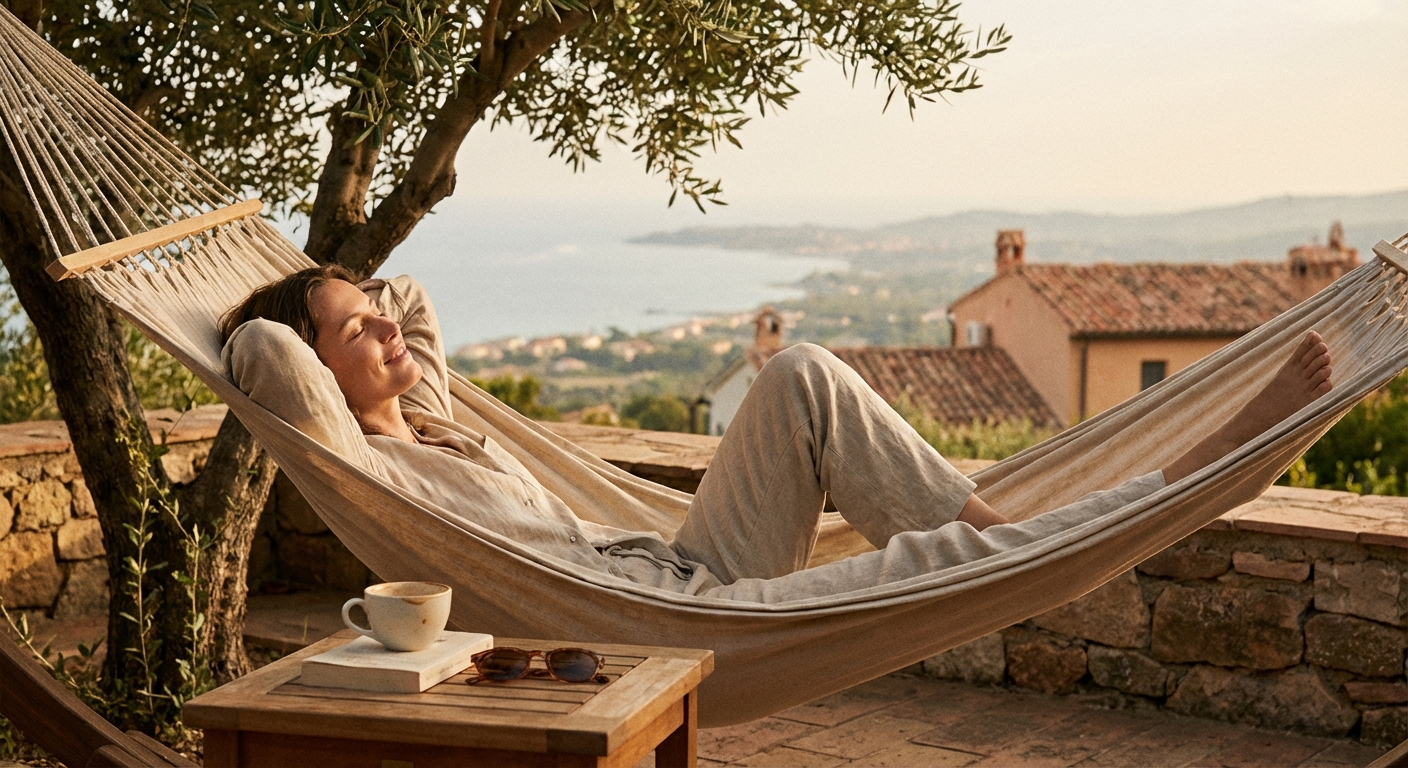
But there is a different way to view time, one that doesn't treat every second as a resource to be mined. It comes from Italy, a culture that has historically understood something we have forgotten. It is called dolce far niente—the sweetness of doing nothing.
This isn't about being lazy. It isn't about giving up. It is about reclaiming your humanity from a world that wants to turn you into a machine. It is the radical act of stopping, taking a breath, and simply existing without an agenda. And right now, it might be the only thing that can save your brain from short-circuiting.
Understanding the Art of Idleness
To the modern, efficiency-obsessed mind, the idea of "doing nothing" sounds like a waste. We have been conditioned to believe that our value is directly tied to our output. If you sit on your porch for twenty minutes without your phone, without a book, and without a plan, you might feel a creeping sense of guilt. You think you should be answering that email. You should be folding laundry. You should be optimizing your life.
Dolce far niente challenges that guilt head-on. In the Italian tradition, this concept distinguishes clearly between idleness and laziness. Laziness is the avoidance of work you know you should do. It is a form of procrastination born from apathy or fear. Idleness, in this context, is entirely different. It is a purposeful, pleasurable state. It is a choice.
Think of it as the difference between starving and fasting. One is something that happens to you; the other is a discipline you undertake for your health. When you practice the sweetness of doing nothing, you are not hiding from your life. You are stepping back to appreciate it. You are allowing yourself to enjoy the passage of time without the need to fill it with "productive" noise.
This requires a shift in perspective. We often use our downtime to numb ourselves. We crash on the couch and binge-watch a series we don't even like, or we scroll endlessly through short-form videos until our eyes glaze over. That is not rest; that is anesthesia. True stillness is active. It is sitting with your coffee and actually tasting it. It is watching the wind move through the trees and noticing the pattern. It is a form of respect for the life you have been given.
The Science Behind the Silence
You might think that when you stop focusing on a task, your brain shuts off. For years, neuroscientists thought the same thing. They assumed the brain went dormant when we weren't solving a math problem or writing a report. But they were wrong.
When you stop focusing on the external world, your brain shifts gears into what is called the Default Mode Network (DMN). This is a massive, energy-intensive network of interacting brain regions that comes alive only when you are "doing nothing."
Think of your brain like a high-performance sports car. When you are working, you are redlining the engine. You are focused, intense, and burning fuel. When you stop, you aren't turning the car off. You are taking it into the shop for diagnostics and repairs.
The DMN is responsible for consolidating memories, processing emotions, and connecting disparate ideas. It is where creativity happens. Have you ever noticed that your best ideas come to you in the shower or while you are driving a familiar route? That is the DMN at work. It can only function when you stop forcing your brain to process new data.
If you never give yourself permission to enter this state—if every spare moment is filled with data input from your phone—you are effectively denying your brain the ability to repair itself. You are keeping the engine redlined until it blows a gasket. That brain fog you feel? That inability to focus? That is your brain begging for some idle time to run its maintenance scripts.
Why You Need It Now
We are currently living through a crisis of exhaustion. The pressure to be "always on" has dissolved the boundaries between work and rest. Our devices follow us into our bedrooms, our bathrooms, and our family dinners. The result is a population that is perpetually wired but functionally burnet out.
Recent data paints a grim picture of our collective mental state, showing that 91% of adults have experienced high or extreme levels of pressure in the past year alone. This isn't just "having a bad week." This is systemic overload. We are seeing record numbers of people stepping away from their careers not because they want to, but because they physically and mentally collapse.
This is why the Slow Living movement and concepts like dolce far niente are moving from niche lifestyle trends to necessary survival strategies. We are realizing that the promise of the digital age—that technology would give us more time—was a lie. Technology has consumed our time.
To resist burnout, we must become militant about our rest. We have to treat stillness with the same seriousness that we treat our gym sessions or our budget meetings. It is a form of discipline. In a noisy world, silence is a rebellion.
Practical Ways to Embrace Stillness
You do not need to move to a Tuscan villa to practice this. In fact, waiting for the perfect vacation to relax is part of the problem. You need to integrate the sweetness of doing nothing into your messy, busy, chaotic Tuesday. Here is how you can start.
1. Reclaim the Gaps
I used to have a massive problem with digital pacifiers. Any time I had a spare three minutes—waiting for the kettle to boil, standing in line at the grocery store, sitting at a red light—I whipped out my phone. I was terrified of being bored. I eventually had to quit gaming and doom-scrolling entirely because I realized I had lost the ability to just sit with my own thoughts.
Stop filling the gaps. When you are in line at the store, just stand there. Look around. People watch. Let your mind wander. These micro-moments of boredom are where your brain takes a breath. Resist the twitch to reach for your pocket.
2. Establish Tech-Free Zones
You cannot find stillness if you are tethered to the hive mind. You need to create physical boundaries for your devices.
- The Bedroom: Keep your phone out of the bedroom. Buy an analog alarm clock. The first thirty minutes of your day and the last thirty minutes of your night should be yours, not the internet's.
- The Dinner Table: No phones during meals. Eating is a sensory experience. Taste your food. Talk to the people you are with. If you are eating alone, just eat.
3. Practice Intentional Observation
This is the core of dolce far niente. It is the act of enjoying the moment for its own sake. Dedicate ten minutes a day to this.
Sit by a window or on a park bench. Do not bring a book. Do not bring headphones. Just sit. Notice the light hitting the pavement. Listen to the distant hum of traffic or the birds. Feel the weight of your body in the chair. It will feel awkward at first. Your brain will scream at you to do something useful. Tell it that this is useful. You are training your attention span.
4. Engage in Analog Hobbies
Find something you can do with your hands that requires a slow, rhythmic focus. Gardening is perfect for this. So is cooking a meal from scratch—chopping vegetables, stirring a pot, waiting for the water to boil.
These activities are restorative because they force you into the physical world. You cannot speed up a tomato plant. You cannot force an onion to caramelize faster. You have to submit to the timeline of reality, which is much slower and more forgiving than the timeline of the internet.
Conclusion
The sweetness of doing nothing is not a luxury reserved for the wealthy or the retired. It is a prerequisite for a healthy life. If you do not make time for stillness, your body will eventually make time for illness.
We have to stop viewing rest as a reward for hard work. Rest is not the prize at the finish line; it is the fuel that gets you there. By embracing dolce far niente, you are making a declaration that you are more than your productivity. You are a human being, designed to think, to dream, and to simply be.
So, today, do something radical. Pour a cup of coffee. Sit in a comfortable chair. And for ten glorious minutes, do absolutely nothing at all. And enjoy every second of it.