We have forgotten the simple power of sitting still and watching the world go by, and it is costing us our sanity.
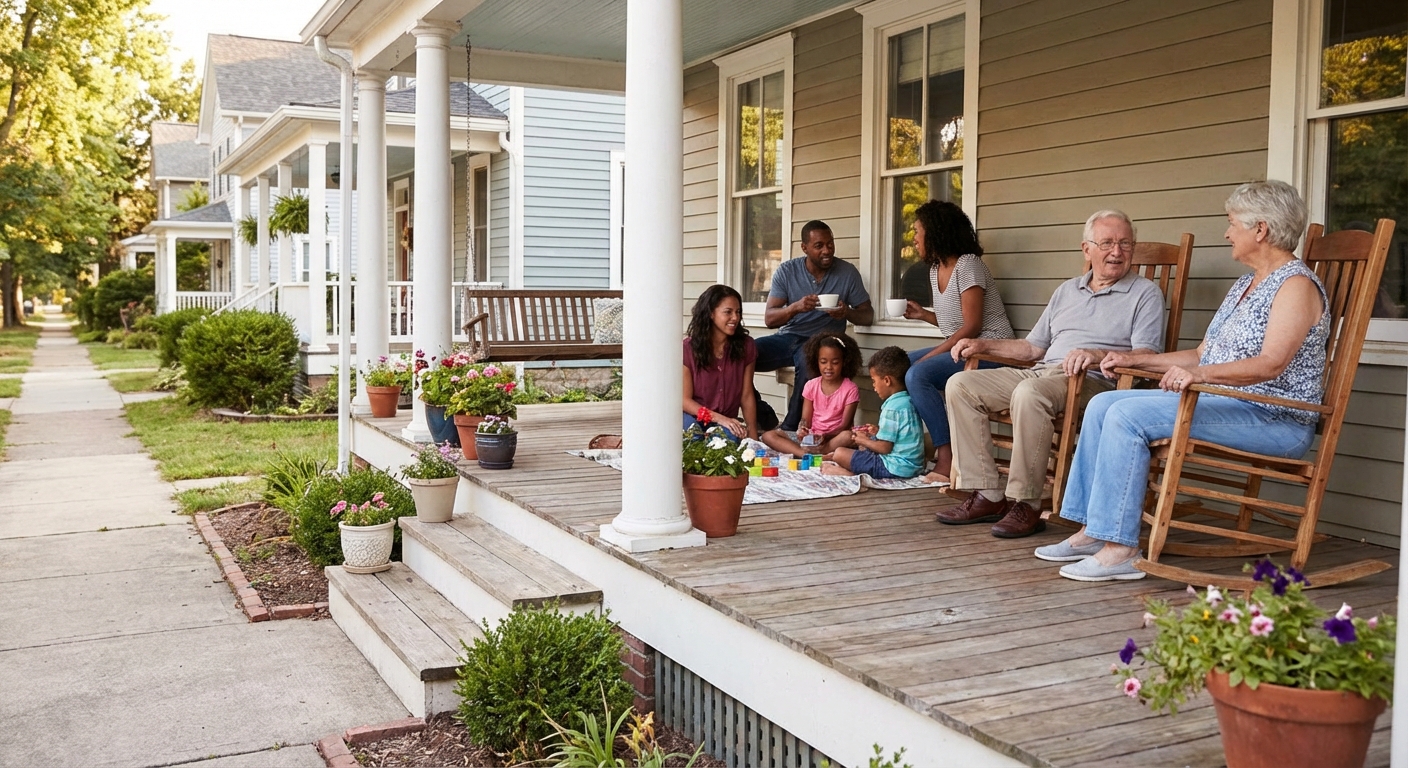
We are living through a paradox that would be funny if it weren’t so painful. We have never been more digitally connected, yet we are in the middle of a loneliness crisis so severe that health organizations are treating it with the same urgency as heart disease. As we look around in March 2026, nearly half of us in urban areas admit to feeling profound emotional isolation. We built faster networks and better phones, but somewhere along the way, we dismantled the physical structures that actually held our communities together.
For decades, we designed our lives for maximum privacy and efficiency. We built automatic garage doors so we could drive straight into our houses without having to speak to a soul. We put up six-foot privacy fences in our backyards to ensure our leisure time was strictly ours. We traded the front porch for the back patio, turning our backs on the street and, by extension, our neighbors.
But the tide is turning. We are realizing that the architecture of our homes dictates the architecture of our relationships. The front porch isn't just a place to leave a wet umbrella or an Amazon package. It is a vital social bridge, a lost art that we desperately need to reclaim.
The Threshold of Community
There is a specific type of magic that happens on a front porch that cannot happen inside a living room. Architects and sociologists call this a "semi-private" zone. It is a threshold.
When you invite someone into your living room, it is a commitment. You have to clean up. You have to offer a drink. There is a social contract of hosting that takes energy. Because of this, we often hesitate to invite neighbors over, especially those we don't know well. The stakes feel too high for a Tuesday evening.
The porch changes the rules of engagement. It is a low-stakes environment. You can be sitting there with a cup of coffee, and a neighbor can walk by walking their dog. You might wave. You might say, "Good morning." You might chat for three minutes about the weather or the local construction down the road.
This interaction is brief, but it is powerful. It allows for connection without obligation. You don't have to entertain them for an hour. They don't have to take their shoes off. It is the perfect incubator for what sociologists call "weak ties"—those casual acquaintanceships that actually form the bedrock of a happy community.
We are seeing a shift in how we build because of this. From the mid-90s to the early 2020s, the number of new homes built with porches skyrocketed from roughly 40% to over 66%. We are instinctively trying to get back to the sidewalk. We are realizing that the "fortress model" of housing, where we hide away in climate-controlled boxes, is bad for our souls.
The porch is the architectural equivalent of an open hand. It signals that you are present. It signals that you are part of the ecosystem of your street, not just a transient resident storing your body and your stuff behind a locked door.
The "Eyes on the Street" Effect
Decades ago, an urbanist named Jane Jacobs coined a phrase that has stuck with me for years: "Eyes on the Street."
Her theory was simple but revolutionary. She argued that a safe neighborhood isn't created primarily by police patrols, cameras, or gated entries. A safe neighborhood is created by the natural, passive surveillance of the people who live there.
When you sit on your porch, you are contributing to the safety of your block. You notice when the streetlights go out. You notice if a strange car has been idling for too long. You notice if the elderly neighbor across the street hasn't picked up their paper yet.
This isn't about being a nosy busybody; it is about collective responsibility. When a street has "porch presence," it feels alive. It signals to anyone passing through that this territory is cared for. It creates a psychological barrier against crime because there is no anonymity.
But it goes deeper than crime prevention. It builds trust. When you see your neighbors outside, even if you don't speak to them every day, they become real people rather than abstract annoyances.
It is easy to get angry at "that guy who parks his truck too close to my driveway" when he is just a faceless villain in your mind. It is much harder to hold onto that anger when you see him sitting on his steps, tying his daughter's shoes or drinking iced tea. Presence humanizes us.
In a world that feels increasingly fractured and suspicious, this passive visibility acts as a social glue. We need to see each other. We need to know that we are not the only ones navigating the chaos of modern life. Seeing a neighbor reading a book on their porch reminds us that life is continuing around us, that we are part of a rhythm larger than our own anxieties.
Practical Steps to Reclaim Your Space
So, how do we actually do this? For many of us, the front porch has become a storage unit or a dead zone. We treat it as a pass-through, not a destination. To change the dynamic of your neighborhood, you have to change your behavior.
First, look at the physical space. If your porch is empty, it is uninviting. You don't need an expensive renovation. You need a place to sit. That is the only requirement.
Get a couple of rocking chairs, a swing, or a simple bench. Comfort matters here. If the chair hurts your back, you won't stay out there long enough for the magic to happen. The goal is to create an environment where you want to linger.
Second, consider the "Leopold bench" approach or simply orienting your furniture toward the street. Too often, we arrange outdoor furniture to face inward, creating a closed circle. Turn your chairs outward. Face the world. It is a subtle invitation to the passerby.
Third, we have to talk about the digital elephant in the room.
I remember a time when my "window to the world" was strictly a glowing rectangle. I’d lose entire weekends to gaming and doom-scrolling, convinced I was engaging with a community, yet I’d turn off the monitor feeling more hollow than when I started. It wasn't until I physically stepped away from the rig and forced myself to sit outside without a device that I realized how much actual life I was filtering out.
You have to implement "Analog Hours." If you sit on your porch with your head buried in a tablet or your phone, you are physically present but socially absent. You are sending a "Do Not Disturb" signal to the world.
Leave the phone inside. Bring a book. Bring a cup of coffee. Or, and this is a radical idea, bring nothing. Just sit. Engage in quiet contemplation. Watch the wind in the trees. Listen to the cars go by.
If you want to take it a step further, look into the "PorchFest" movement. This is a growing trend where neighborhoods coordinate a day where residents turn their porches into stages for local musicians, poets, and artists. People walk from house to house, listening to music, eating food, and actually talking to one another. It turns the private home into a public asset for a day.
But you don't need a festival to start. You just need to open the door and sit down.
The Science of Why This Matters
You might think that sitting on a porch is just a nice, nostalgic idea, but the biological reality is much more significant.
We know now that chronic social isolation is a killer. The data suggests that loneliness carries a mortality risk comparable to smoking 15 cigarettes a day. It increases inflammation, spikes cortisol, and degrades our cognitive function.
The interactions you have on a porch—the wave, the nod, the brief comment about the humidity—act as a buffer against this. These "weak ties" provide a sense of belonging that is distinct from the deep intimacy of family or close friends. They anchor us in a place. They tell our brains that we are safe and that we are known.
Furthermore, there is the biophilic aspect. We are designed to be outside. We are not designed to live under fluorescent lights 24 hours a day.
Stepping out onto the porch exposes you to natural light, which regulates your circadian rhythm and helps you sleep better. It exposes you to fresh air. Even the visual complexity of nature—trees, clouds, the movement of leaves—has a proven ability to lower blood pressure and reduce mental fatigue.
Your brain’s CEO gets tired, just like you do. Constant focus on screens and work tasks depletes your prefrontal cortex. Soft fascination, like watching a squirrel run up a tree or watching traffic pass by, allows your attention to recharge.
A Return to Radical Presence
We have spent the last twenty years rushing. We rushed to build faster internet, faster deliveries, and faster lives. We optimized our homes for isolation and our schedules for productivity. And in the process, we lost the art of simply being where we are.
Reclaiming the front porch is an act of rebellion against this speed. It is a declaration that you have time. It is a statement that you value your physical community over your digital one.
It requires discipline. It is easier to stay on the couch. It is easier to hide in the backyard. But the easy path has led us to a place of profound loneliness.
Go outside. Sit down. Look at the street. Say hello to the person walking by. It might feel awkward at first. You might not know what to do with your hands without a phone in them. But stay there.
In that stillness, you might find that the cure for your isolation was right outside your front door the whole time.