It is March 2026, and if you are feeling a deep, vibrating exhaustion in your bones, you are not alone; you are just paying attention to a world that has forgotten how to stop.
The Universal Tension
We are currently living through a moment of unprecedented "change exhaustion." Just this month, on March 4, 2026, Deloitte released their "Global Human Capital Trends" report. The findings were not exactly surprising, but they were damning. They found that the average worker is now navigating roughly 15 major organizational shifts every single year.
Think about that for a second. That is more than one massive upheaval per month. We are constantly restructuring, re-skilling, and pivoting. The report calls this era "From Tensions to Tipping Points." It reveals that while 85% of leaders scream that adaptability is critical, only a tiny fraction—7%—actually feel equipped to help their teams handle this relentless pace.
We are running a race where the finish line keeps moving ten yards back every time we take a step. We have been sold a narrative that if we just hustle hard enough, optimize our calendars perfectly, and utilize every AI tool available, we will eventually reach a state of bliss. We are working ourselves to the bone to buy a future where we can finally rest.
But there is a quieter, older wisdom that cuts through this noise like a knife. It suggests that the life we are breaking our backs to afford is often the very life we are neglecting right now.
The Parable of the Fisherman and the Banker
There is a story often attributed to the writer Heinrich Böll. It is not new, but in the context of our 2026 burnout crisis, it hits harder than ever before.
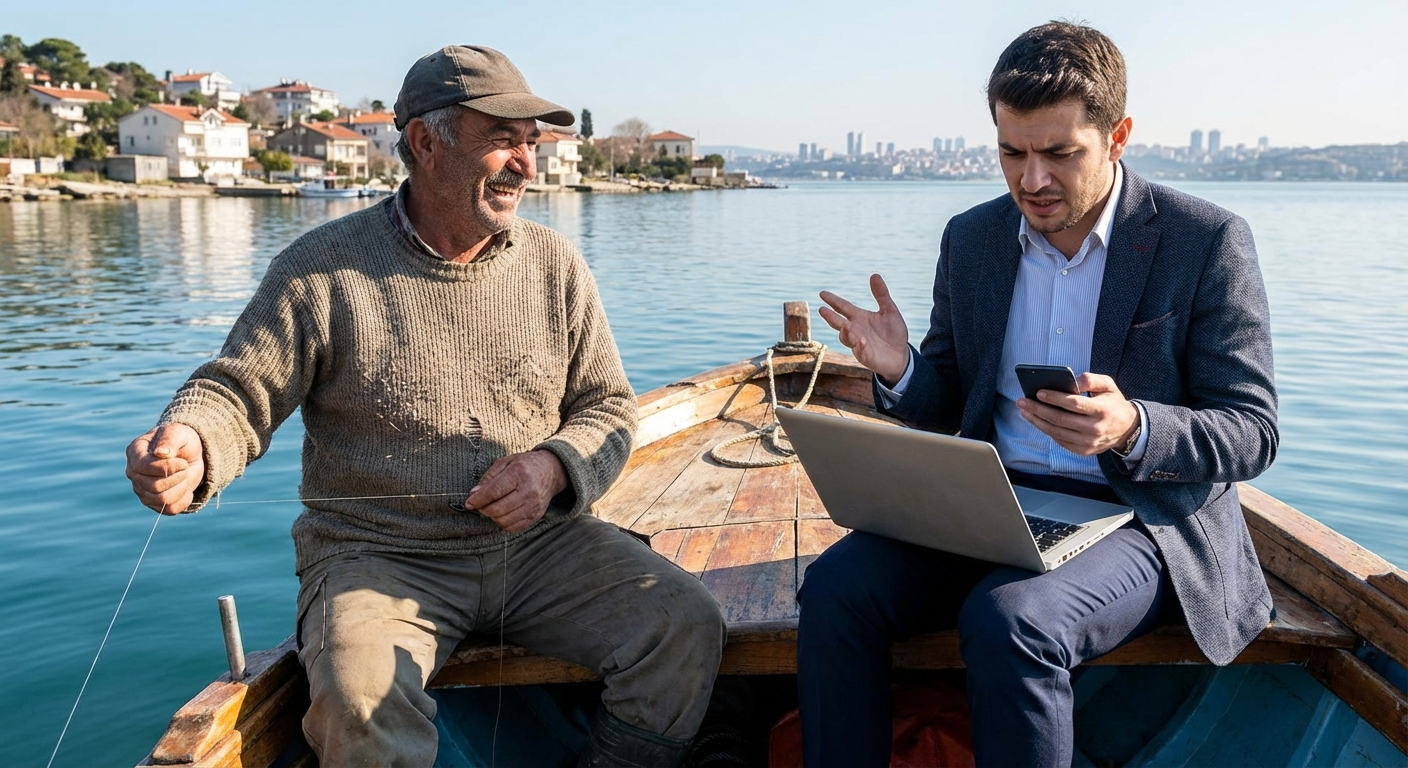
The story goes like this: An American investment banker was at the pier of a small coastal Mexican village when a small boat with just one fisherman docked. Inside the small boat were several large yellowfin tuna. The American complimented the Mexican on the quality of his fish and asked how long it took to catch them.
The Mexican replied, "Only a little while."
The American then asked why didn't he stay out longer and catch more fish?
The Mexican said he had enough to support his family’s immediate needs.
The American then asked, "But what do you do with the rest of your time?"
The Mexican fisherman said, "I sleep late, fish a little, play with my children, take siestas with my wife, stroll into the village each evening where I sip wine and play guitar with my amigos. I have a full and busy life."
The American scoffed, "I am a Harvard MBA and could help you. You should spend more time fishing and with the proceeds, buy a bigger boat. With the proceeds from the bigger boat, you could buy several boats, eventually, you would have a fleet of fishing boats. Instead of selling your catch to a middleman you would sell directly to the processor, eventually opening your own cannery. You would control the product, processing, and distribution. You would need to leave this small coastal fishing village and move to Mexico City, then LA and eventually New York City, where you will run your expanding enterprise."
The Mexican fisherman asked, "But, how long will this all take?"
To which the American replied, "15 to 20 years."
"But what then?" asked the Mexican.
The American laughed and said, "That’s the best part. When the time is right you would announce an IPO and sell your company stock to the public and become very rich, you would make millions!"
"Millions – then what?"
The American said, "Then you would retire. Move to a small coastal fishing village where you would sleep late, fish a little, play with your kids, take siestas with your wife, stroll to the village in the evenings where you could sip wine and play your guitar with your amigos."
The High Cost of the "Wait 20 Years" Strategy
The irony is painful because it is real. The banker’s roadmap to success was a twenty-year detour to get back to exactly where the fisherman started.
This is the trap of the "deferred life plan." We convince ourselves that autonomy and peace are rewards reserved for the end of the game. We treat our current well-being as a currency we must spend to buy future freedom.
The data shows this transaction is bankrupting us. As of early 2026, 83% of global workers report experiencing some degree of burnout. This is an all-time high, driven by the "always-on" digital expectations that follow us home, into our beds, and into our dreams. We are seeing a massive disconnect between means and ends.
I know this trap intimately. For years, as a web developer and marketer juggling multiple complex projects, I operated under the delusion that if I just took on "one more" client or pushed through one more crunch period, I would finally earn the right to breathe. I was constantly grinding, coding late into the night, and neglecting my health, convinced that "future me" would be the one to enjoy the freedom I was building. But "current me" was just miserable, anxious, and physically stagnant. It wasn't until I adopted a strategy of deep-work bursts—intense focus followed by genuine, guilt-free downtime—that I realized I didn't need to wait for retirement to own my schedule. I could structure my life to have that freedom today, simply by changing how I worked.
The banker in the story isn't evil; he is just blind. He views time as something to be leveraged for future value. The fisherman views time as the value itself.
When we look at the burnout statistics, we see the cost of the banker's mindset. Burnout-related disengagement is currently costing the global economy an estimated $322 billion annually. That is billions of dollars lost because people are simply too exhausted to care anymore. We are trading our actual lives for a hypothetical future that may never arrive, or worse, one that we will be too broken to enjoy when it does.
Practical Steps to Redefine Your Success
So, how do we stop acting like the banker and start living a bit more like the fisherman, without actually quitting our jobs and moving to the coast? We have bills to pay, after all. The answer lies in sustainable success—redefining achievement through the lens of time-wealth and autonomy rather than just accumulation.
Here is how we apply this in the current 2026 landscape:
1. Conduct a "Workload Audit" and Redesign Your Role
The first step is to stop measuring your success by hours logged. In 2026, smart organizations are shifting toward "job design" that prioritizes autonomy. You need to do this for yourself. Look at your week. Where are you leaking energy?
Are you sitting in meetings that could be emails? Are you doing "busy work" to appear productive? The fisherman didn't cast his net into empty waters just to look busy. He fished where the fish were, caught what he needed, and went home. Audit your tasks. If a task does not directly contribute to your "catch" (your core output or income), ruthless elimination or delegation is necessary.
2. Embrace "Slow Productivity"
There is a growing movement that pushes back against the frantic busyness of the last decade. It is called "Slow Productivity," popularized by thinkers like Cal Newport. It is built on three pillars:
- Do fewer things: Stop trying to juggle ten projects at once. Pick two that matter and ignore the rest.
- Work at a natural pace: Humans are not machines. We have rhythms. You cannot sprint a marathon.
- Obsess over quality: The fisherman didn't catch a thousand tiny, worthless fish. He caught high-quality tuna. When you produce high-quality work, you gain leverage. That leverage buys you freedom.
3. Implement "Microshifting"
The traditional 9-to-5 block is dead. In its place, we are seeing the rise of "microshifting." This is the practice of breaking your labor into short, non-continuous blocks.
Instead of chaining yourself to a desk for eight hours (where you are likely only productive for three), you work in intense bursts. Maybe you do a two-hour deep work session in the morning, then take a two-hour break to exercise, pray, or be with your family. Then, you do another burst in the afternoon.
This allows you to integrate the "fisherman lifestyle"—the siestas, the family time, the community—into your working years, rather than waiting for retirement. It protects your time for personal responsibilities and stillness.
Conclusion
The Mexican Fisherman parable is not a call to laziness. Catching tuna by hand is hard work. It is a story about "enough."
In a world obsessed with "more"—more data, more growth, more speed—knowing what "enough" looks like is a competitive advantage. It gives you a finish line. It allows you to step off the treadmill.
We are entering an era where cognitive clarity and emotional regulation are the most valuable assets a human being can possess. You cannot have clarity when you are exhausted. You cannot regulate your emotions when you are burning out.
Success is not the number in your bank account at the end of the game. Success is the ownership of your time right now. Do not wait twenty years to live the life you already have the ingredients for today.