

You pick up the mail, glance at a bill, sigh, and toss it onto the kitchen counter to "deal with later," effectively guaranteeing that you will stress about it five more times before you actually pay it.
That single moment of hesitation is the enemy of a peaceful home.
We have all been there. You come home tired, your hands are full, and the path of least resistance is to create a pile. But that pile isn't just paper; it is postponed decisions. It is a physical manifestation of procrastination that slowly eats away at your mental energy.
In 2026, the trend in home organization has shifted away from the sterile, impossible standards of "extreme minimalism." We are no longer trying to live in empty white boxes. Instead, we are moving toward "intentional decluttering." This approach acknowledges that you have a life, you have stuff, and you have responsibilities. The goal isn't to own nothing; the goal is to build a system that handles the influx of daily life without friction.
To make this work, you need a rule that is absolute, unbreakable, and simple enough to remember when you are exhausted. You need the OHIO rule.
The Core Philosophy of OHIO
OHIO stands for "Only Handle It Once."
It sounds simple, almost too simple to be effective, but it is a powerhouse strategy used by high-level executives and productivity experts for decades. It was popularized by Robert Pozen, a senior lecturer at MIT and former financial executive, in his book Extreme Productivity. Pozen realized that most people drown in work not because the work is too hard, but because they touch the same task over and over again without moving the needle.
Think about your current relationship with your mail or your email inbox. You pick up a letter. You open it. You realize it requires you to call your insurance company. You don't want to make the call right now, so you put the letter back in the pile.
Two days later, you pick up the pile to find a receipt. You see the insurance letter again. You feel a spike of guilt. You put it back down.
By the time you finally make that five-minute phone call, you have "handled" that piece of paper ten times. You have wasted precious mental energy worrying about it, shuffling it, and ignoring it.
This behavior is called "churning." It is the act of moving items from one pile to another, or from the table to the desk, without making a decision. Churning is comfortable in the moment because it feels like you are organizing. You aren't. You are just rearranging your anxiety.
The OHIO rule demands immediate action. When you pick up an item, you are not allowed to put it down until you have decided its fate. You must close the loop. This requires a level of discipline that can feel uncomfortable at first, but the payoff is a stillness in your home that you haven't felt in years.
Eliminating the Paper Nightmare
Paper is the most insidious form of clutter because it is flat. It stacks easily. You can ignore a three-inch stack of mail on the counter for weeks until it suddenly slides over and spills across the floor. To apply the OHIO rule effectively, you need a tactical approach. You cannot just "try harder." You need a framework.
1. Identify Your Hot Spots
First, stop lying to yourself about where the paper goes. You probably have "drop zones" where clutter naturally accumulates. Usually, this is the kitchen island, the entryway table, or a specific corner of your desk.
In the past, you might have tried to force yourself to walk every piece of paper to a filing cabinet in the basement. That will never work. You are human, and you are tired. Instead, establish your OHIO station right at the source. If the pile grows on the kitchen counter, that is where you must stand and fight the battle.
2. The 4D Framework
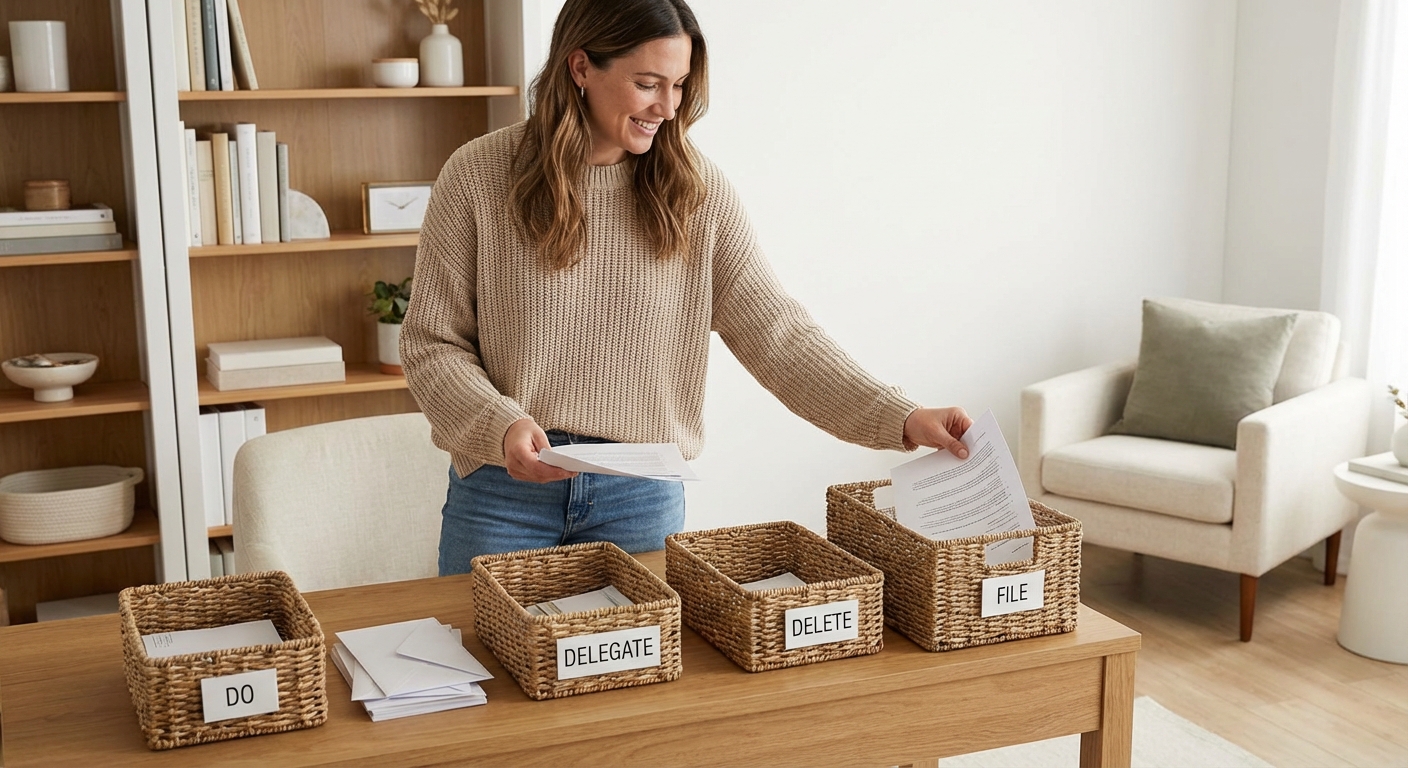
When you pick up a piece of paper (or open an email), you must immediately choose one of four actions. You cannot put it back down until you do one of these things:
Do It
If the task associated with the paper takes less than two minutes, do it immediately. Do not think about it. Just do it.
- Is it a permission slip for your kid? Sign it and put it in their backpack.
- Is it a bill? Open your banking app and pay it right there.
- Is it an RSVP? Text the host.
The time you spend "saving it for later" is often longer than the time it takes to just finish the task.
Delegate It
This is often overlooked in household management. If the paper belongs to someone else, get it into their hands immediately.
- If it is a letter for your spouse, do not put it in a pile for them. Hand it to them or put it on their pillow.
- If it is a form your teenager needs to fill out, hand it to them and stand there until they take it.
You are not the household filing cabinet. Stop carrying the mental load for everyone else.
Defer It
This is the danger zone. "Defer" does not mean "put it in a pile." It means putting the document in a specific place where it will be handled at a specific time.
- If you need to dispute a credit card charge and it will take 30 minutes, you probably can't do it while cooking dinner. That is fine.
- But you must put that paper in a dedicated "To-Do" folder and—this is crucial—put an appointment on your calendar to handle that folder.
- If it is a tax document, it goes instantly into the "2026 Taxes" envelope. It does not sit on the desk waiting for a friend.
Delete It
This is my favorite option. Most of what enters your home is garbage. Junk mail, flyers, coupons you will never use, newsletters you never read.
- Be ruthless. If you hesitate, throw it out.
- If you can find the information online later, throw the paper out.
- If you haven't used that Bed Bath & Beyond coupon in three years, throw it out.
3. Close the Loop Completely
There is a catch to the OHIO rule. A decision isn't enough; the item must physically leave your immediate space.
If you decide to "Delete" a piece of junk mail, but you leave it on the counter to "walk to the recycle bin later," you have failed. You are double-handling. The rule is only fulfilled when the paper is in the bin.
If you decide to "Donate" a magazine, it must go into the donation box in your trunk, not on the floor by the door. 2026 experts warn that sorting is only half the job. The item must be evicted from your living space to prevent it from creeping back into the ecosystem.
The Science of Single-Handling
You might be thinking, "This sounds intense. Why can't I just relax and deal with the mail on Saturday?"
You can, but you are paying a high price for that procrastination. The OHIO rule isn't just about a clean counter; it is about a clear mind. There is legitimate psychology backing this up, and understanding it can help you stick to the discipline.
The Zeigarnik Effect
Psychologists call it the Zeigarnik Effect. It describes the tendency of the human brain to remember uncompleted or interrupted tasks better than completed ones.
Your brain is a loop-closing machine. When you leave a task unfinished—like seeing a bill and not paying it—your brain opens a "loop." It keeps a small portion of your attention fixated on that task, running in the background like a smartphone app draining your battery.
If you have fifty pieces of paper in a pile, you have fifty open loops. This creates a low-level hum of anxiety that follows you around the house. It prevents you from finding true stillness. When you handle an item once and finish it, you close the loop. Your brain can let go. The silence that follows is palpable.
Decision Fatigue
Your brain is not an infinite resource. It is more like a battery. Every time you make a choice, you drain a little bit of power. This is known as decision fatigue.
Research shows that the quality of your decisions deteriorates as the day goes on. By the time you get home from work, your "CEO brain" is exhausted.
When you churn paper—picking it up, looking at it, putting it down—you are forcing your brain to make micro-decisions over and over again. "Should I do this now? No. Where should I put it? Here." You are wasting your limited decision-making energy on junk mail.
By using the OHIO rule, you automate the small stuff. You preserve your mental stamina for the things that actually matter, like listening to your family or solving real problems.
I know this struggle intimately. Years ago, I was juggling a dozen web development clients while trying to meet marketing deadlines for my own projects. I would open my inbox, see a complex request from a client, get a knot in my stomach, and mark it as "unread" so I could deal with it later. I would do this five or six times a day for the same email. It paralyzed me. My focus was shattered because I had these open loops screaming for attention. Once I started forcing myself to either reply immediately or schedule a specific block to handle it, the anxiety vanished. I stopped drowning in the "maybe later" and started living in the "done."
Conclusion
The OHIO rule is not about being perfect. It is about being pragmatic. It is about recognizing that your time and your peace of mind are more valuable than a stack of coupons.
Moving from a habit of "double-handling" to "single-handling" takes practice. You will slip up. You will find yourself building a pile on the dining table. When that happens, don't beat yourself up. Just stop, pick up the top item, and ask yourself: "Do, Delegate, Defer, or Delete?"
Clear the pile. Close the loops. Reclaim your space. When you stop shuffling the papers of your life, you finally have the freedom to actually live it.
