You love your partner. You just don’t like sleeping with them.
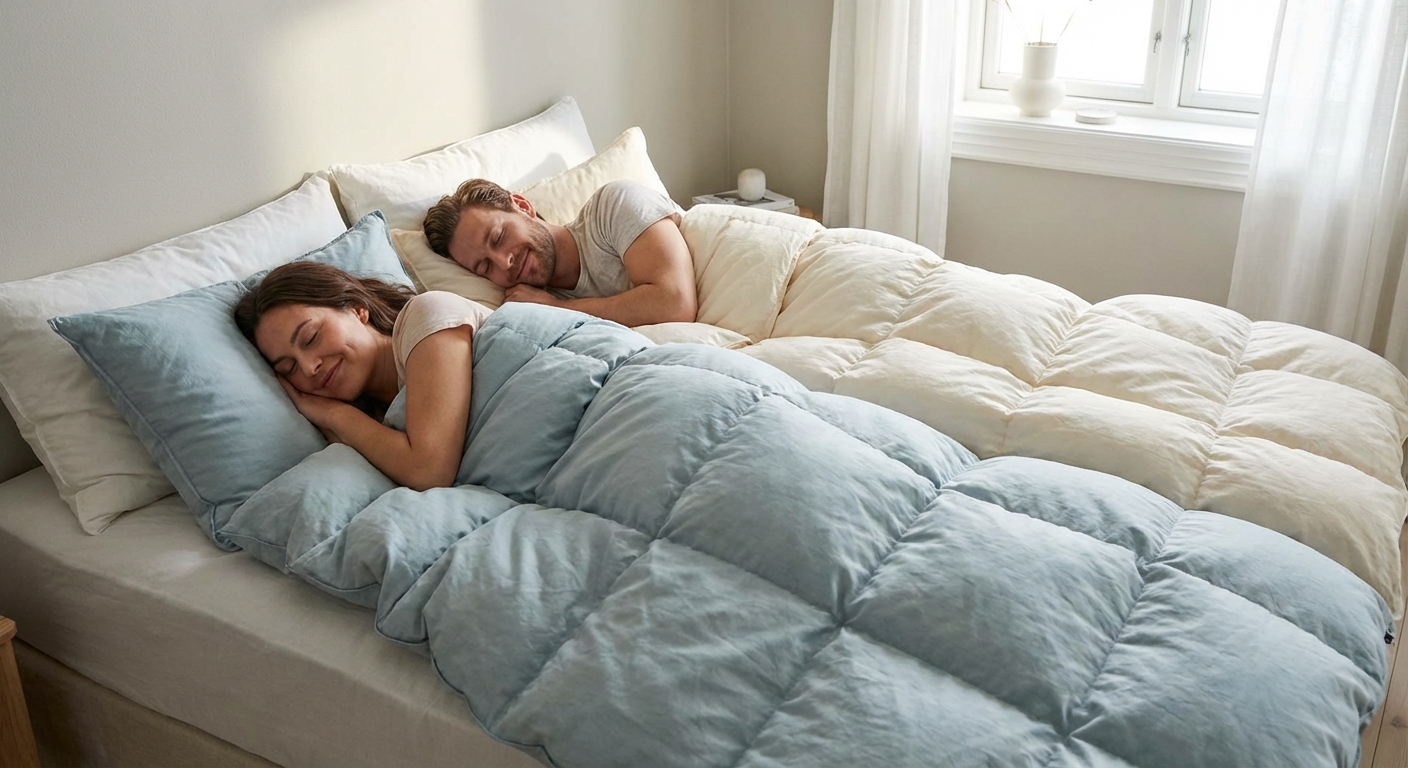
It starts innocently enough. You climb into bed, maybe share a few minutes of conversation, and settle in for the night. But three hours later, the war begins. You wake up shivering because they’ve rolled over and taken seventy percent of the comforter with them. Or worse, you wake up in a pool of sweat because they radiate heat like a blast furnace, and the shared blanket has trapped you in a tropical micro-climate you didn’t sign up for.
For years, we’ve been told that sharing a bed means sharing everything—the mattress, the top sheet, and the duvet. We treat the bed as a single unit. But physiologically, you and your partner are two completely different systems. You have different metabolic rates, different temperature preferences, and different movement patterns. Trying to force those two systems to operate under one heavy layer of fabric is a recipe for disaster.
There is a way to fix this without sleeping in separate rooms. It’s a simple, low-tech adjustment that has been standard practice in Sweden, Denmark, and Norway for generations. It’s called the Scandinavian Sleep Method, and if you are tired of waking up exhausted, it might just save your sanity.
The Science of “Sleep Harmony”
The core problem with the traditional “one big duvet” setup is that it ignores basic biology. To enter deep sleep and stay there, your body needs two specific things: a drop in core temperature and physical stillness.
When you share a single comforter, you are essentially trapping the body heat of two people in a confined space. This creates an environment that fights against your body’s natural need to cool down. If your partner runs hot, that heat transfers to you. Your body has to work overtime to regulate its temperature, which leads to “micro-awakenings.” You might not remember waking up, but your sleep cycle is disrupted, and you wake up feeling groggy and unrefreshed.
Then there is the issue of motion transfer. Every time your partner shifts, rolls over, or gets up to use the bathroom, that movement ripples across the shared bedding. It pulls the fabric taut, lets in a draft of cold air, or simply jostles you awake.
This isn’t a minor annoyance; it’s a statistical epidemic. In fact, research indicates that approximately 80% of couples in relationships experience sleep disruptions caused by their partner, with nearly one-third of those disturbances stemming specifically from movement.
The Scandinavian Sleep Method solves both problems simultaneously by ditching the shared comforter. Instead, you use two separate, twin-sized duvets on the same large mattress.
It sounds almost too simple to work, but the impact is immediate. By having your own duvet, you create a personal “micro-climate.” You can regulate your own temperature without affecting your partner. Furthermore, the physical gap between the two blankets acts as a firewall for movement. If your partner tosses and turns, their duvet moves with them, but yours stays perfectly still. You stay asleep, and the peace is maintained.
The Setup: Practical Steps to Implementation
Implementing this method requires a shift in mindset and a small investment in bedding, but the payoff is worth it. You don’t need expensive gadgets or trackers; you just need to re-engineer your sleep environment.
Here is the step-by-step breakdown of how to set this up effectively:
Buy Two Twin Duvets.
Forget the King or Queen size comforter. You need two separate twin-sized duvets. This ensures that you have ample coverage to wrap yourself up like a burrito if you want to, without stealing an inch of fabric from your partner.Customize Your Warmth.
This is the game-changer. Since the duvets are separate, they don’t have to match in weight or material. If you are a “hot sleeper,” get a lightweight, breathable linen or percale duvet. If your partner is always freezing, let them get a heavy, down-filled option.I remember when I was heavier—before I lost 110 pounds and stopped binge eating—I was a furnace at night. I would radiate heat that made sharing a bed unbearable for anyone else. Now that I’ve kept the weight off, I run cold. If I were still trying to share a single blanket with a “hot sleeper” today, one of us would be miserable. This method allows you to cater to those specific metabolic needs without compromise.
Ditch the Top Sheet.
This is often the hardest part for Americans to accept, but it is crucial. The Scandinavian method typically eliminates the top sheet entirely. The top sheet just becomes a tangled mess at the bottom of the bed anyway. You sleep directly under the duvet (which should have a washable cover). This maximizes your freedom of movement and eliminates the friction of tangled linens.Master the aesthetic fold.
One worry people have is that their bed will look messy with two blankets. It won’t. The trick is how you make the bed in the morning. You lay each twin duvet flat, then fold it in half lengthwise so it sits neatly on its respective side of the bed. It creates a clean, symmetrical look that suggests order and discipline.Cool the Room.
To fully embrace the philosophy, borrow one more habit from the North: open a window for a few minutes before bed, even in cooler months. Let the fresh air drop the ambient temperature of the room. Because you are now wrapped in your personalized duvet, you will stay warm, but the fresh, cool air will help signal your brain that it is time for rest.
The Relationship Dividend
There is a strange stigma in our culture that suggests sleeping under separate blankets—or even in separate beds—is a sign of a failing relationship. We call it “sleep divorce,” a term loaded with negativity.
We need to reframe this immediately. Prioritizing your health and your partner’s rest is an act of love, not separation.
When you are sleep-deprived, you are irritable. Your patience is shorter. Your ability to handle stress evaporates. The prefrontal cortex—the part of your brain responsible for emotional regulation—essentially goes offline when you are exhausted. This leads to snapping at your partner over dirty dishes or misinterpreting a harmless comment as an attack.
By removing the nocturnal battle for the covers, you remove a significant source of unconscious resentment. You aren’t waking up angry because they stole the sheets. You aren’t waking up sweaty and annoyed. You are waking up rested.
Intimacy does not require you to be unconscious and uncomfortable together for eight hours. Intimacy happens when you are awake. It happens in the quiet moments before sleep—perhaps during prayer or while reading—and it happens in the morning when you have the energy to engage with each other.
The Scandinavian Sleep Method actually preserves intimacy because it removes the physical discomfort of the sleeping arrangement. You can still cuddle before drifting off. But when it’s time to actually sleep—the physiological act of repairing your body and brain—you retreat to your own side, under your own cover, and get the job done.
Conclusion
We tend to overcomplicate health. We look for the newest supplement, the most advanced wearable tracker, or the most complex morning routine. But often, the barriers to our well-being are environmental.
If you are struggling with insomnia or restless nights, look at your environment first. Are you fighting a nightly battle against temperature and movement? Are you sacrificing your biological need for stillness just to adhere to a cultural norm about how a bed “should” look?
Simplicity usually wins. Two duvets. No top sheet. A cool room. It’s a pragmatic solution to a biological problem. Give yourself permission to be comfortable. Your sleep, and likely your relationship, will be better for it.