You might think your weight struggle is a lack of willpower, but it is actually a design flaw. Your kitchen layout is likely sabotaging your goals, and fixing it is easier than starting another diet.
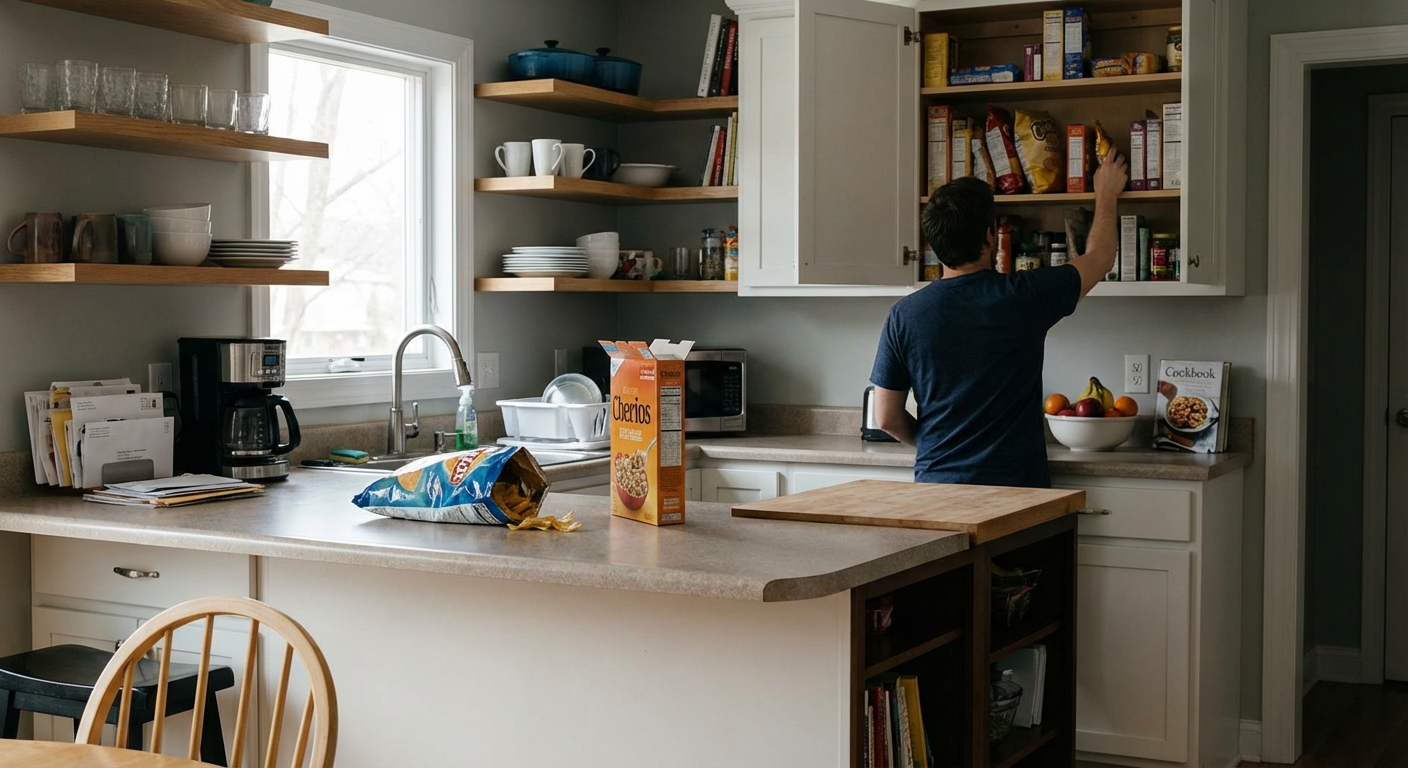
The Core Idea: Environment Beats Willpower
We like to believe we are rational decision-makers. We tell ourselves that we eat because we are hungry and stop when we are full. We think we choose a salad over a slice of pizza because we have disciplined character.
But the reality is much simpler and a little more humbling. We are visually driven creatures.
Behavioral economics and decades of research suggest that we are "mindless eaters." We respond to cues in our environment far more than we respond to the growling of our stomachs. Your brain’s CEO—the part responsible for logic and long-term planning—gets tired, just like you do. By the time you get home from work, your willpower battery is drained.
If your kitchen is designed to work against you, you will lose that battle every single time.
The good news is that you don't need a stronger will. You need a smarter floor plan. By redesigning your kitchen to favor health, you remove the need for constant discipline. You stop fighting your environment and start making it work for you.
The "See-Food" Phenomenon
There is a very simple rule that dictates the waistlines of most families: What you see is what you eat.
It sounds almost too obvious to be true, but the data backs it up. The visibility of food on your kitchen counter is one of the most accurate predictors of your Body Mass Index (BMI). If it is within your line of sight, your brain registers it as an option, even if you aren't hungry.
Cornell research highlighted a staggering statistic regarding this phenomenon. In their studies, women who kept a box of breakfast cereal on their kitchen counters weighed an average of 20 pounds more than their neighbors who kept the cereal in the cupboard.
Twenty pounds. Just from the placement of a cardboard box.
The reverse is also true. The same research found that households with a fruit bowl visible on the counter weighed an average of 13 pounds less.
This isn't magic. It is about the path of least resistance. When you walk into the kitchen to grab a glass of water or check the mail, your brain scans the room. If it sees a bag of chips or a box of crackers, it triggers a craving that wasn't there five seconds ago.
I know this from hard experience. Back when I was carrying an extra 110 pounds, my kitchen was an obstacle course of temptation. I kept a box of "healthy" protein bars right next to the coffee maker. I told myself they were for emergencies, but because I saw them every morning, every morning became an emergency. I didn't stop the cycle of snacking until I stopped relying on my willpower and physically hid the food in an opaque bin on the top shelf.
You have to hide the "health halos" too. Just because something is organic or gluten-free doesn't mean it should be sitting out. Granola bars, nuts, and high-calorie health snacks trigger the same "grazing" behavior as junk food. Put them away.
The "Serve Here, Eat There" Strategy
Once you have cleared the counters, the next battlefield is dinner itself. Most of us grew up with "family style" dining. You put the big serving bowls of pasta, potatoes, and meat right in the center of the dining table. It feels warm and communal.
It is also a disaster for portion control.
When the food is sitting two feet away from your plate, the "cost" of getting seconds is zero. You don't have to get up. You don't have to stop the conversation. You just reach out and scoop.
This is where the "Serve Here, Eat There" rule changes the game.
The strategy is simple: Keep the food on the stove or the kitchen counter. Serve the plates there, and then carry the plates to the dining table. Leave the serving dishes behind.
This creates physical friction. If you want seconds, you have to make a conscious decision. You have to push back your chair, stand up, and walk across the room. That short walk gives your brain just enough time to catch up with your stomach.
It forces you to ask, "Am I actually still hungry, or am I just eating because the taste is still in my mouth?"
The research on this is compelling. Men who use this strategy reduce their calorie intake by nearly 29%. Women reduce theirs by around 20%. That is a massive calorie deficit achieved without changing a single ingredient in the meal. You are simply adding a speed bump to the process.
Plate Engineering and Visual Illusions
Your eyes are constantly lying to you, especially when it comes to portion sizes.
We judge how much we are eating not by the absolute volume of food, but by how that food looks relative to the plate. A four-ounce serving of steak looks miserable and tiny on a massive 12-inch dinner plate. It leaves so much "white space" that your brain perceives scarcity. You feel deprived before you even take the first bite.
However, put that same four-ounce steak on a 9-inch plate, and it looks robust. It fills the visual field.
This is the "Small Plate Movement." Over the last few decades, the average size of a dinner plate in American homes has grown significantly. As the plates got bigger, so did our waistlines.
Transitioning back to 9-inch or 10-inch plates can reduce your consumption by roughly 30%. You are essentially tricking your appetite. You serve yourself less food because the plate looks full sooner.
This requires a bit of humility. It feels childish to eat off smaller plates. But if you are serious about managing your weight, you have to accept that your brain is easily fooled. Use the illusion to your advantage.
The Wellness Kitchen of 2026
As we move through 2026, we are seeing a major shift in home design trends that aligns perfectly with this philosophy. The "Wellness Kitchen" is becoming the dominant standard, moving away from the open-concept chaos of the past decade.
We are seeing a rise in "back kitchens" or secondary prep zones. These are small, tucked-away spaces where the mess happens, allowing the main kitchen area to remain clean and serene.
Why does this matter for your waistline? Because clutter causes stress, and stress causes eating.
A chaotic environment triggers a biological response. When you walk into a kitchen piled high with mail, dirty dishes, and random knick-knacks, your cortisol levels spike. Cortisol is the stress hormone, and for many of us, the immediate antidote to a cortisol spike is sugar and fat.
Cornell researchers found that women in a chaotic, cluttered kitchen consumed twice as many cookies as those in a tidy environment when they were stressed. The visual noise creates mental noise, and we eat to silence it.
You might not be able to build a "back kitchen" or renovate your home this year. But you can embrace the principle of the Wellness Kitchen by ruthlessly decluttering.
Clear the counters. Not just of food, but of everything. The mail does not belong on the island. The blender does not need to be out if you only use it on Saturdays.
When your kitchen is a place of stillness and order, you are less likely to use food as a drug to numb your anxiety. You create a space where cooking feels like an act of care, not a frantic chore to be rushed through.
Designing for Discipline
We often treat health as a moral test. We think that if we were just "better" people, we wouldn't eat the cookies. But relying on character to solve a biology problem is a recipe for failure.
You have to be pragmatic. You have to assume that you will be tired, stressed, and hungry. You have to assume that your willpower will fail.
So, design a kitchen that has your back when you are at your weakest.
Remove the visual cues. Create friction between you and the second helpings. Shrink the plates to match the portions you actually need. Clear the clutter to lower your stress.
These aren't diet tips. They are structural changes. A diet requires you to wake up every morning and make the right choice. A kitchen redesign makes the right choice for you, day after day, year after year.
Start with your countertops today. It is the single most effective step you can take toward a lighter, healthier life.